
How Accurate Is Your Fitness Tracker, Really?
Modern wearables promise a window into your health — but how much of what they show can actually be trusted? A close look at the research reveals a more complicated picture than the marketing suggests.

Gadgifyr
December 1, 2025
6 min
Real - World Performance
⚙️Step counting is consistently reliable across major brands in controlled settings, making wearables a dependable tool for measuring daily movement and general activity levels.
⚙️Resting heart rate is tracked with high precision by top devices, supporting their use for detecting unusual resting-state changes over time.
⚙️Calorie data should not be used to make nutrition or weight management decisions — no tested brand achieves acceptable accuracy, with errors frequently exceeding 30%.
⚙️Sleep tracking is useful for identifying broad patterns and long-term changes but should not be treated as an equivalent to clinical sleep assessment.
⚙️Users with darker skin tones may experience systematically lower accuracy in heart rate and SpO2 readings, particularly during vigorous exercise — a limitation requiring both awareness and regulatory attention.
⚙️AFib detection features show encouraging specificity, meaning false positives are relatively rare, but sensitivity gaps mean some real cases may not be flagged.
Good to Know
🔍No wearable brand has proven accurate for calorie counting — errors typically exceed 30%, regardless of device or brand.
🔍Wearable accuracy is not uniform across skin tones — some devices underestimate heart rate by more than 20% during exercise in users with darker skin.
🔍Clinical sleep studies (PSG) remain the gold standard — consumer wearables overestimate total sleep time and cannot yet reliably classify sleep stages.
🔍AFib detection is promising but not diagnostic — the technology catches roughly 4 in 5 actual cases, meaning some will go undetected.
🔍Laboratory results may not reflect real-world performance — many validation studies are conducted under controlled conditions that differ from daily life.
🔍SpO2 (blood oxygen) readings from wearables carry wide individual variability — the average may be accurate, but a single reading can be off by several percentage points.
🔍Wearable devices are continuously being upgraded — published accuracy studies often lag behind current hardware, meaning results may not reflect the latest models.
Smartwatches and fitness trackers have quietly become one of the fastest-growing categories in consumer technology. Worn by millions around the world, these devices promise to monitor everything from heart rate and sleep quality to calorie burn and blood oxygen — all from the wrist.
As wearables become more capable, they are increasingly positioned not just as fitness companions, but as tools for personal health management. That shift has made understanding their scientific accuracy more important than ever.
DID YOU KNOW?
No wearable brand has been shown to measure calorie expenditure accurately. Across multiple systematic reviews covering dozens of devices and thousands of test sessions, energy expenditure error rates consistently exceeded 30% — making calorie data the least reliable metric across all tested brands.
The technology at the heart of most wearable health sensors is called photoplethysmography, or PPG — a method that shines light (typically green) onto the skin and measures how much is reflected back, which changes as blood pulses through the vessels. This approach works well in controlled conditions, but its reliability changes depending on movement, skin temperature, and — critically — skin tone.
Melanin, the pigment responsible for darker skin, absorbs more green light, which can interfere with the sensor's readings. Research has found that some brands underestimate heart rate by 10 to 15 beats per minute at rest, and by more than 20% during intense exercise, specifically in users with darker skin tones — a disparity that points to a significant equity problem in how these devices are designed and validated.
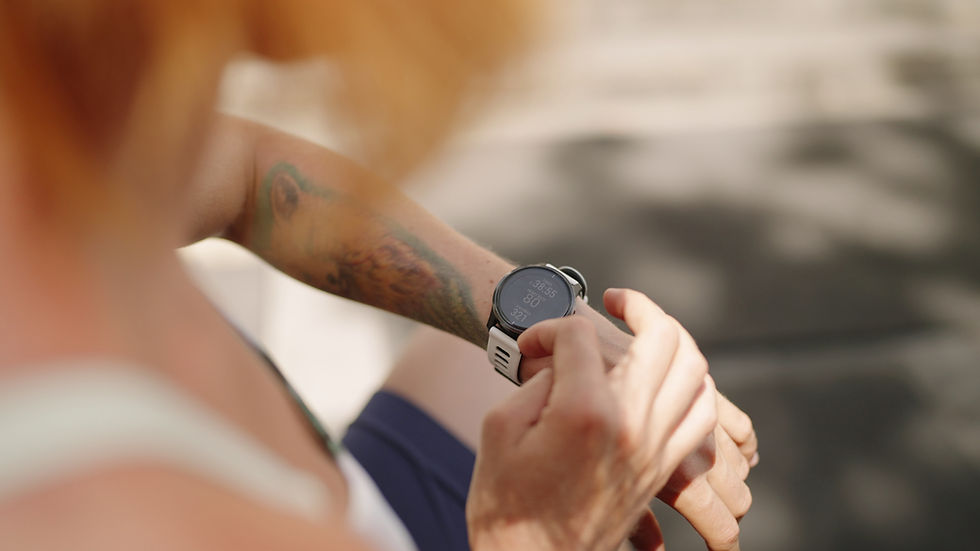
When it comes to step counting, wearables perform well. Multiple large-scale reviews found that major brands including Fitbit, Apple Watch, and Samsung measured steps accurately in laboratory conditions, with some devices maintaining a mean error below 25% even across a wide range of user types and activity intensities. Heart rate at rest is also measured with reasonable precision — one large meta-analysis covering more than 430,000 participants found Apple Watch's average heart rate underestimation was less than 0.3 beats per minute, though with moderate variability around that average.
In a clinical hospital setting, four consumer-grade trackers — including Apple Watch, Garmin, Withings, and Fitbit — were tested against electrocardiography (ECG, the medical gold standard for heart rhythm) in patients recovering from surgery, and all four achieved a correlation coefficient of 0.95 or higher, suggesting real promise for hospital monitoring. Sleep tracking tells a more complicated story. When compared against polysomnography (PSG) — the clinical gold standard involving full brain and body monitoring during sleep — consumer wearables consistently overestimate total sleep time and underestimate how much time is spent awake after initially falling asleep.
Devices are generally better at detecting whether someone is asleep or not than at correctly classifying sleep stages like light, deep, or REM sleep. Among tested devices, the Apple Watch Series 8 showed the highest agreement with PSG for sleep staging, followed closely by the Fitbit Sense and Fitbit Charge 5 — though even the best results still fell short of clinical accuracy. Blood oxygen saturation (SpO2) showed low average bias in large-scale analysis, but with wide limits of agreement — meaning individual readings could be off by several percentage points in either direction, which matters when SpO2 is being used as a health signal.
WORTH NOTING
Sleep tracking accuracy varies significantly by device and by metric. Wearables tend to perform better at identifying total sleep versus wakefulness, but struggle to classify sleep stages correctly. The gap with polysomnography is meaningful enough that physicians advise interpreting wearable sleep data as a general guide rather than a clinical measurement.
The atrial fibrillation (AFib) detection feature now present on many premium smartwatches has attracted significant scientific attention. Research shows these devices are more specific than sensitive — meaning they are better at correctly confirming the absence of AFib than at catching every case. A specificity of around 91% and sensitivity of around 79% are promising but not yet reliable enough for clinical diagnosis on their own.
Energy expenditure remains the weakest area across all devices and all brands reviewed — with errors frequently exceeding 30%, no brand has demonstrated reliable calorie tracking, making this metric the one most likely to mislead users who are managing weight or nutrition through their device data.
KEY STATISTICS
≥0.95
Correlation coefficient
Achieved by all four tested consumer trackers against ECG in postoperative hospital patients — a strong signal of real-world clinical potential.
−0.27
Average HR underestimation
Apple Watch's mean heart rate bias across 430,000+ participants is -0.27 bpm — impressively small on average, though individual variation can be much larger.
±4%
SpO2 limits of agreement
Even with low average bias, blood oxygen readings can deviate by up to 4 percentage points from clinical measurements, limiting diagnostic use.
Taken together, the evidence suggests that wearables are genuinely useful tools for tracking trends — particularly steps, resting heart rate, and broad sleep patterns — while remaining limited for clinical or high-stakes health decisions.
Accuracy varies not just by brand and model, but by the individual wearing the device, their skin tone, their activity level, and the specific metric being measured. As the technology continues to evolve, so too must the standards used to validate it.
RELATED READING

Gadgifyr could not find any relatable books about this topic that were not to advanced and/or technical.
-

EVIDENCE-BASED RELIABILITY
78%
Overall Score
7
Sources Used
6
Claim Types
22%
82%
41%
Heart rate accuracy
Calorie tracking accuracy
Long-term Studies
Based on multiple peer-reviewed systematic reviews and meta-analyses covering hundreds of thousands of data points, the evidence base is solid for step and heart rate claims. Calorie tracking is consistently poor across all devices. Long-term validation studies remain limited, reducing confidence in sustained real-world accuracy.
Step count
Good
Heart rate (rest)
Good
Sleep latency
Moderate
HR (exercise)
Moderate
Calorie burn
Poor
Atrial fibrillation
Moderate
AT A GLANCE - METRIC ACCURACY
The Consumer Takeaway
Consumer wearables have made remarkable progress in bringing health monitoring to the wrist. For millions of people, they offer a genuinely useful window into daily activity, resting heart rate, and broad sleep patterns — metrics that can meaningfully support healthier habits over time. But the science is clear that the accuracy of these devices is uneven, and the claims made by manufacturers often outpace what the research supports. Step counting holds up well. Resting heart rate is tracked with reasonable precision.
Sleep staging, calorie burn, and blood oxygen measurement all fall short of what would be required for clinical reliability. Perhaps most importantly, the research reveals a systematic accuracy gap related to skin tone — a bias rooted in sensor design that affects a substantial proportion of users and has received insufficient attention from both manufacturers and regulators. The right way to use a wearable is as a trend tracker, not a diagnostic tool — a device that helps notice patterns and prompt conversations with healthcare professionals, rather than replace them.
Fuller, D., Colwell, E., Low, J., Orychock, K., Tobin, M. A., Simango, B., Buote, R., Van Heerden, D., Luan, H., Cullen, K., Slade, L., & Taylor, N. G. A. (2020). Reliability and validity of commercially available wearable devices for measuring steps, energy expenditure, and heart rate: Systematic review. JMIR mHealth and uHealth, 8(9), e18694. https://doi.org/10.2196/18694
Lambe, R., Baldwin, M., O'Grady, B., Schumann, M., Caulfield, B., & Doherty, C. (2026). The accuracy of Apple Watch measurements: A living systematic review and meta-analysis. npj Digital Medicine, 9, 63. https://doi.org/10.1038/s41746-025-02238-1
Helmer, P., Hottenrott, S., Rodemers, P., Leppich, R., Helwich, M., Pryss, R., Kranke, P., Meybohm, P., Winkler, B. E., & Sammeth, M. (2022). Accuracy and systematic biases of heart rate measurements by consumer-grade fitness trackers in postoperative patients: Prospective clinical trial. Journal of Medical Internet Research, 24(12), e42359. https://doi.org/10.2196/42359
Lee, Y. J., Lee, J. Y., Cho, J. H., Kang, Y. J., & Choi, J. H. (2025). Performance of consumer wrist-worn sleep tracking devices compared to polysomnography: A meta-analysis. Journal of Clinical Sleep Medicine, 21(3), 573–582. https://doi.org/10.5664/jcsm.11460
Schyvens, A.-M., Peters, B., Van Oost, N. C., Aerts, J.-M., Masci, F., Neven, A., Dirix, H., Wets, G., Ross, V., & Verbraecken, J. (2025). A performance validation of six commercial wrist-worn wearable sleep-tracking devices for sleep stage scoring compared to polysomnography. PMCID: PMC12038347.
Asif, S., AlSaafeen, A., Nadar, S., Nambiar, S., Dannawi, J., Korrapati, N. H., & Wilkhoo, H. S. (2025). Photoplethysmography in diverse skin tones: Evaluating bias in smartwatch health monitoring. Cureus. https://doi.org/10.7759/cureus.94074
Germini, F., Noronha, N., Borg Debono, V., Abraham Philip, B., Pete, D., Navarro, T., Keepanasseril, A., Parpia, S., de Wit, K., & Iorio, A. (2022). Accuracy and acceptability of wrist-wearable activity-tracking devices: Systematic review of the literature. PMCID: PMC8817215.
DID YOU GET ANY OF THAT?
Read a summarization of this page's content in question-answer format ▽ (click to open and collapse the content)
Why do wearables struggle so much with calorie counting?
Calculating energy expenditure requires accounting for a person's metabolic rate, body composition, movement efficiency, and even body temperature — variables that wrist sensors simply cannot measure directly. The estimates are based on algorithms built from population averages, which means they can be meaningfully off for any individual, and the error compounds during exercise when conditions change rapidly.
Is it safe to rely on my smartwatch for AFib detection?
Wearable AFib detection can serve as a useful early prompt to seek medical attention, but it should not be treated as a diagnostic tool. A sensitivity of around 79% means roughly one in five real AFib episodes may go undetected. Any suspected irregularity flagged by a wearable — or any symptom that suggests a heart rhythm issue — should be confirmed with a clinical ECG.
Does wearing a device on a different wrist or position affect accuracy?
Fit and placement have been identified as factors that influence measurement accuracy, particularly for optical heart rate sensors. A loose fit or placement too far from the wrist bone can reduce the quality of the light signal reaching the sensor. Most manufacturers recommend snug but comfortable placement on the non-dominant wrist for optimal readings.
Should people with darker skin tones trust their wearable's health data less?
The research suggests that PPG-based sensors — used for heart rate and SpO2 — can be measurably less accurate in people with higher levels of skin melanin, particularly during exercise. This is not a reason to avoid wearables, but it is a reason to interpret the data with greater caution and to raise concerns with healthcare providers if readings seem inconsistent with how one feels.
How can I use my wearable in the most useful way given its limitations?
The most evidence-supported use of a consumer wearable is for tracking personal trends over time — monitoring whether resting heart rate is rising, whether sleep duration is changing, or whether daily step counts are declining. Comparing one reading to a fixed health target is less reliable than noticing consistent patterns, and any health concern prompted by wearable data should prompt a conversation with a medical professional rather than a self-diagnosis
Gadgets Connected to These Scientific Insights
The gadgets shown here each rely on the science discussed in this article — sometimes directly, sometimes through a clever variation of the same underlying technology.
For the best experience, we recommend reading the summary first. It gives you a quick, clear understanding of how the technology works and helps you decide whether these gadgets match what you’re looking for.

This review covers an Amazon product offered through affiliate links. Gadgifyr may earn a small commission if you buy — at no extra cost to you.

Seller:
Amazon
Amazfit Bip 6 Smart Watch
A long-lasting Zepp OS smartwatch that combines a large AMOLED display, built-in GPS with offline maps, and everyday health, fitness, and notification features.
Explore other Gadget Related Articles:

Timers, Breaks, and the Science of Staying Focused
Millions swear by the 25-minute Pomodoro timer — but does science actually support that specific number, or is the real story more complicated?

AI Planners, Voice Assistants, and Real Productivity
Everyone's using voice assistants and apps to stay organized — but does any of it actually make you more productive, or is paper still winning in some ways?

Air Purifiers, Disinfectants, and Your Immune System
Everyone's heard that being 'too clean' can backfire on your immune system — but is that actually true, or is something else going on?

1 / 16


About Gadgifyr
We uncover and review gadgets that genuinely make life better — from boosting focus and energy to improving everyday comfort and wellbeing.
No exaggerations, no empty promises. Just real reviews, grounded research, and practical tech that adds value — not noise.
When a gadget makes bold claims, we test the facts, check the science, and give you the clarity you need to decide with confidence.
Join the Gadgifyr Community
Stay ahead of the curve, together.
Get involved with a community that loves smart gadgets, real reviews, and tech that actually improves life.
Subscribe to the Newsletter
No spam. Just smart tech.
Get new reviews, science insights, and hand-picked gadget drops straight to your inbox.
Explore Gadgifyr's Blogs

Gadgifyr
August 24, 2026
-
14 min read
Training Smarter: The Science of Effective Muscle Growth
A myth-checked, research-based look at what genuinely drives muscle growth — and where popular fitness claims outpace the science.
Category

Gadgifyr
January 27, 2026
-
12 min read
Heat vs. Cold Therapy: What Ice Baths, Saunas, and Contrast Therapy Actually Do
A science-backed look at heat and cold therapy — from cold plunges and saunas to contrast therapy — covering what's proven, what's still early, and which recovery gadgets hold up.
Category

Gadgifyr
February 11, 2026
-
15 min read
What plant-derived oils can realistically do for hair, sleep, mood, and everyday wellbeing
An honest, research-based breakdown of what essential oils can realistically do for sleep, hair, mood, and daily wellbeing — plus the gadgets built around them.
Category


