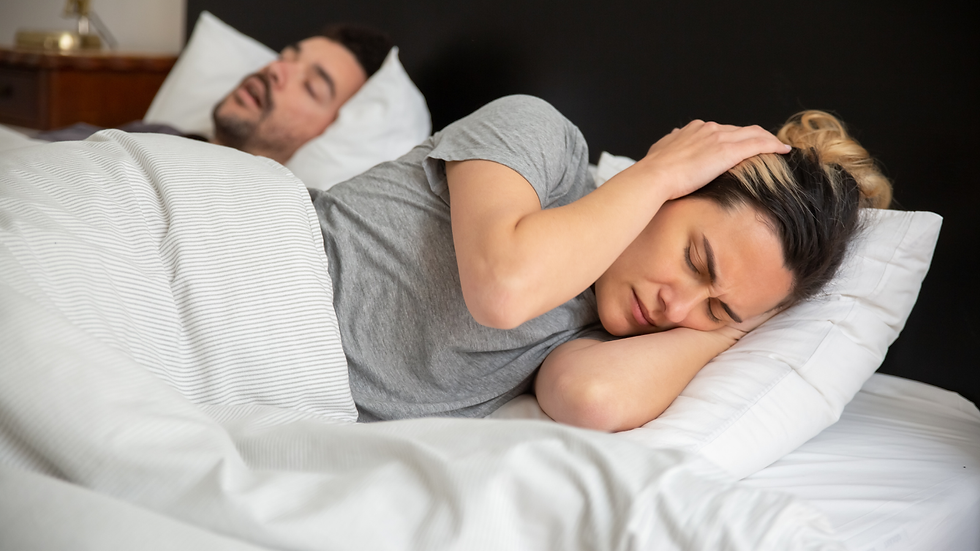
Effects of Snoring on Health and Wellbeing
Snoring happens when airflow is partly blocked and soft throat tissues vibrate during sleep. Recent large studies suggest it is not only disruptive, but also tied to measurable cardiovascular and daytime health risks, even when sleep apnea is not clearly present.
What the Science Says
Snoring is often treated like a harmless annoyance, but physiologically it is a sign that breathing is meeting resistance during sleep. When the upper airway narrows, each breath can create vibration and turbulence instead of smooth airflow.
That matters because sleep is when the body is supposed to run its “maintenance mode”: blood pressure normally dips, the brain consolidates memory, and the cardiovascular system gets a break. If breathing is repeatedly strained or sleep is repeatedly disrupted, those restorative processes can be weakened, and the consequences show up both at night and during the day.
One of the clearest signals in the research is blood pressure. A 2024 study used an under-the-mattress sensor to objectively track snoring over months in 12,287 participants, then compared those long-term snoring patterns to repeated home blood-pressure readings. People who spent more of the night snoring had higher systolic and diastolic blood pressure, even after accounting for age, sex, body mass index, and an estimated apnea–hypopnea index (a common measure used to estimate sleep apnea).
Importantly, higher snoring exposure (75th vs. 5th percentile; about 12% vs. 0.04% of sleep time) was linked to an approximately 1.9× higher odds of uncontrolled hypertension (≥140/90 mmHg based on averaged readings). The association also remained in a subgroup with an estimated apnea–hypopnea index below 5 events/hour (often treated as “no sleep apnea”), where more snoring was still linked to higher odds of uncontrolled hypertension.
Mechanistically, the authors describe plausible pathways: partial obstruction can produce strong negative pressure swings inside the chest and brief awakenings that create blood-pressure surges, while ongoing tissue vibration may stress nearby structures. Even without proving direct causality, these findings are clinically meaningful because small average blood-pressure increases across a population can translate into higher long-term cardiovascular risk.

Snoring also tends to cluster with other problems that affect health and functioning. In a large Swedish survey (25,901 adults), the group reporting both snoring and insomnia symptoms showed the strongest associations with several conditions: hypertension (adjusted OR ~1.4), asthma (OR ~1.9), COPD (OR ~1.8), and especially daytime sleepiness (OR ~7.9), along with higher use of hypnotic medications (OR ~7.5). This matters because daytime sleepiness is not just inconvenient; it can impair attention, reaction time, and workplace or driving safety. Supporting that broader picture, a U.S. population analysis (BRFSS sleep module) found snorers reported shorter sleep time, more insufficient sleep days, more unintentional sleep episodes, and higher odds of falling asleep while driving (OR ~1.49).
That same analysis found increased odds of coronary artery disease and depressive disorder among snorers, though stroke was not significantly associated in that dataset. Meanwhile, a large Chinese screening program analysis in adults over 40 found snoring grouped with higher prevalence of several stroke-related risk factors (including hypertension, diabetes, hyperlipidemia, and atrial fibrillation) and a higher proportion classified as high risk for stroke.
Taken together, the evidence does not say “snoring always causes disease,” but it consistently shows that regular snoring often travels with measurable cardiometabolic strain and reduced daytime wellbeing, making it a symptom worth taking seriously rather than ignoring.
Related Books ▼

Real - World Performance
⚙️ Tracking snoring over many nights (not just one) better reflects real exposure and aligns with stronger links to uncontrolled hypertension seen in long-term monitoring.
⚙️ Snoring plus insomnia symptoms is a higher-risk combination, strongly tied to daytime sleepiness and associated respiratory and blood-pressure conditions.
⚙️ Snoring is associated with worse sleep patterns and higher odds of drowsy driving indicators, which can affect safety and performance.
Good to Know
🔍 Snoring is a sign of airflow resistance: tissues vibrate because the airway is partially narrowed, not because the body is “sleeping well.”
🔍 In multi-month monitoring, more time spent snoring was linked to ~1.9× higher odds of uncontrolled hypertension, even after adjusting for estimated sleep apnea.
🔍 Primary snoring still mattered: the hypertension association persisted even in people below an estimated sleep-apnea threshold.
🔍 The combo of snoring + insomnia symptoms showed the highest association with daytime sleepiness (OR ~7.9) in a large Swedish survey.
🔍 Snorers reported more insufficient sleep and higher odds of nodding off while driving in a U.S. population analysis.
🔍 A Chinese screening analysis found snoring clustered with higher prevalence of stroke risk factors, which can raise overall vascular risk profiles.
🔍 Not every snorer has sleep apnea, and not every sleep-apnea patient reports snoring—single-question self-report can miss important patterns.
🔍 If snoring is paired with severe sleepiness, choking/gasping, or witnessed pauses, it suggests sleep-disordered breathing that deserves medical evaluation.

Evidence-Based Reliability Score
Large samples and one multi-month objective snoring study strengthen confidence, but most findings are observational.
83%
The Consumer Takeaway
Snoring is not just a social problem; it often signals strained breathing during sleep. Across large studies, regular snoring is linked to higher blood pressure and a greater likelihood of uncontrolled hypertension, even when estimated sleep apnea is accounted for. Snoring also tends to appear alongside poorer sleep and daytime sleepiness, which can reduce focus and increase safety risks.
The most practical lesson is to treat persistent snoring like a health symptom: track how often it happens, notice whether sleep feels unrefreshing, and pay attention to daytime fatigue. If snoring comes with choking, gasping, or witnessed breathing pauses, it is especially important to seek assessment, because the health burden may be bigger than the noise suggests.
Bhattacharyya, N. (2015). Sleep and health implications of snoring: A populational analysis. Laryngoscope, 125(10), 2413–2416. https://doi.org/10.1002/lary.25346
Hägg, S. A., Ilieva, E., Ljunggren, M., Franklin, K. A., Middelveld, R., Lundbäck, B., Janson, C., & Lindberg, E. (2022). The negative health effects of having a combination of snoring and insomnia. Journal of Clinical Sleep Medicine, 18(4), 973–981. https://doi.org/10.5664/jcsm.9764
Lechat, B., Naik, G., Appleton, S., Manners, J., Scott, H., Nguyen, D. P., Escourrou, P., Adams, R., Catcheside, P., & Eckert, D. J. (2024). Regular snoring is associated with uncontrolled hypertension. npj Digital Medicine, 7, Article 38.
Zhang, Y., Zhang, T., Xia, X., Hu, Y., Zhang, C., Liu, R., Yang, Y., Li, X., & Yue, W. (2023). The relationship between sleep quality, snoring symptoms, night shift and risk of stroke in Chinese over 40 years old. Frontiers in Aging Neuroscience, 15, 1134187. https://doi.org/10.3389/fnagi.2023.1134187
DID YOU GET ANY OF THAT?
Read a summarization of this page's content in question-answer format ▽ (click to open and collapse the content)
Why would snoring affect blood pressure if someone “doesn’t have sleep apnea”?
In the long-term monitoring study, snoring time was linked to uncontrolled hypertension even in people below an estimated sleep-apnea threshold. This supports the idea that partial obstruction and repeated arousals may still strain the cardiovascular system.
Is snoring mainly a problem because it ruins sleep quality?
Sleep disruption is part of it, but the research also points to physical effects from obstructed breathing, such as pressure swings and stress responses that can raise blood pressure. Snoring can be both a sleep-quality issue and a breathing-mechanics issue.
What’s the risk of snoring plus insomnia compared with snoring alone?
In the Swedish survey, the combined group (snoring + insomnia symptoms) had the highest associations with multiple outcomes, especially daytime sleepiness. The pairing may signal a heavier overall sleep burden.
Does snoring automatically mean stroke risk is higher?
Not automatically. Different datasets report different stroke findings, but snoring often clusters with major stroke risk factors like hypertension and metabolic markers, which can raise overall vascular risk profiles.
Why do studies emphasize measuring snoring over many nights?
Snoring (and sleep-disordered breathing in general) can vary a lot from night to night. Multi-night or multi-month tracking better represents typical exposure than a single “snapshot” night.
Gadgets Connected to These Scientific Insights
The gadgets shown here each rely on the science discussed in this article — sometimes directly, sometimes through a clever variation of the same underlying technology.
For the best experience, we recommend reading the summary first. It gives you a quick, clear understanding of how the technology works and helps you decide whether these gadgets match what you’re looking for.

This review covers an Amazon product offered through affiliate links. Gadgifyr may earn a small commission if you buy — at no extra cost to you.

Seller:
Amazon
WoodyKnows Side-Sleeping Backpack
Inflatable side-sleeping position trainer with adjustable straps and chest support to help limit back-sleeping for throat-related snoring.

Explore other Gadget Related Articles:

Smart Yoga Mats: Useful Coach or Hype?
Smart yoga mats can provide real-time feedback that may speed up learning for some beginners, but they are not required for yoga’s core benefits.

From Pore Vacuums to Blue Light: What Actually Treats Acne, and What Doesn’t
A science-driven breakdown of how acne develops, whether suction gadgets and blue light therapy can treat or prevent it, and the most effective alternatives for maintaining healthy, clear skin.

From Heat to Electricity: What Really Works for Period Cramp Pain?
Heat, gentle electrical stimulation, and some self-care habits can reduce period cramps for many people, but the best results usually come from combining proven methods rather than relying on one gadget.

1 / 15


About Gadgifyr
We uncover and review gadgets that genuinely make life better — from boosting focus and energy to improving everyday comfort and wellbeing.
No exaggerations, no empty promises. Just real reviews, grounded research, and practical tech that adds value — not noise.
When a gadget makes bold claims, we test the facts, check the science, and give you the clarity you need to decide with confidence.
Join the Gadgifyr Community
Stay ahead of the curve, together.
Get involved with a community that loves smart gadgets, real reviews, and tech that actually improves life.
Subscribe to the Newsletter
No spam. Just smart tech.
Get new reviews, science insights, and hand-picked gadget drops straight to your inbox.
Explore Gadgifyr's Blogs


Gadgifyr
January 11, 2026
-
5 min
Focus Mode On: 6 Work-From-Home Upgrades That Actually Help
Working from home? Discover six gadgets that keep you focused, organized, and in control—without overcomplicating your workspace.
Category

Gadgifyr
January 7, 2026
-
6 min
The Sleep Fix: Science-Backed Ways to Sleep Deeper and Wake Better
Struggling with restless nights? Discover what science really says about how to fall asleep faster, sleep deeper, and wake restored.
Category

Gadgifyr
January 10, 2026
-
6 min
Science-Backed Skin Tech: What Really Works and What Still Needs Proof
Can light, electricity, and heat truly transform your skin? A closer look at the science behind today’s most talked-about technologies.
Category


