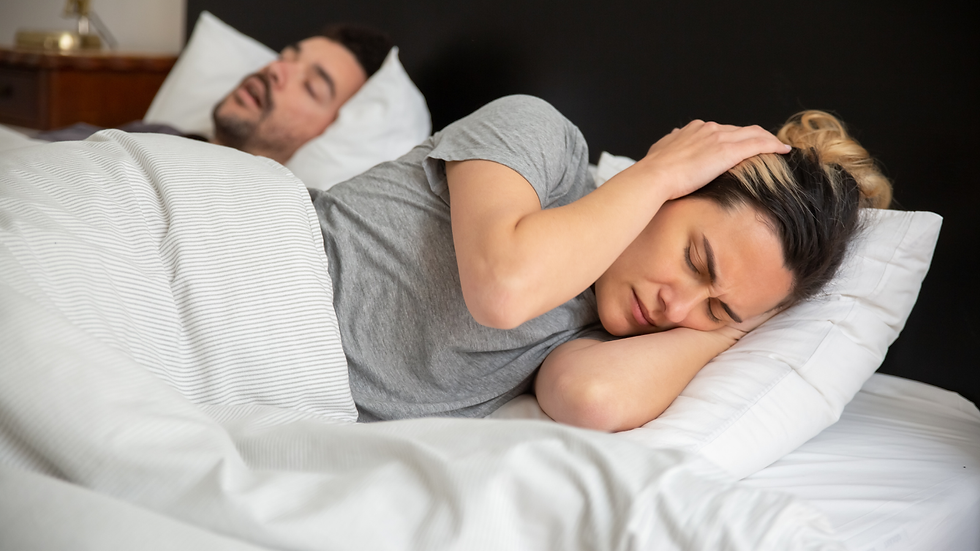
Effects of Snoring on Health and Wellbeing
Snoring happens when airflow is partly blocked and soft throat tissues vibrate during sleep. Recent large studies suggest it is not only disruptive, but also tied to measurable cardiovascular and daytime health risks, even when sleep apnea is not clearly present.
Real - World Performance
⚙️ Tracking snoring over many nights (not just one) better reflects real exposure and aligns with stronger links to uncontrolled hypertension seen in long-term monitoring.
⚙️ Snoring plus insomnia symptoms is a higher-risk combination, strongly tied to daytime sleepiness and associated respiratory and blood-pressure conditions.
⚙️ Snoring is associated with worse sleep patterns and higher odds of drowsy driving indicators, which can affect safety and performance.
Good to Know
🔍 Snoring is a sign of airflow resistance: tissues vibrate because the airway is partially narrowed, not because the body is “sleeping well.”
🔍 In multi-month monitoring, more time spent snoring was linked to ~1.9× higher odds of uncontrolled hypertension, even after adjusting for estimated sleep apnea.
🔍 Primary snoring still mattered: the hypertension association persisted even in people below an estimated sleep-apnea threshold.
🔍 The combo of snoring + insomnia symptoms showed the highest association with daytime sleepiness (OR ~7.9) in a large Swedish survey.
🔍 Snorers reported more insufficient sleep and higher odds of nodding off while driving in a U.S. population analysis.
🔍 A Chinese screening analysis found snoring clustered with higher prevalence of stroke risk factors, which can raise overall vascular risk profiles.
🔍 Not every snorer has sleep apnea, and not every sleep-apnea patient reports snoring—single-question self-report can miss important patterns.
🔍 If snoring is paired with severe sleepiness, choking/gasping, or witnessed pauses, it suggests sleep-disordered breathing that deserves medical evaluation.
Add a Title
Add paragraph text. Click “Edit Text” to update the font, size and more. To change and reuse text themes, go to Site Styles.
Add a Title
Add paragraph text. Click “Edit Text” to update the font, size and more. To change and reuse text themes, go to Site Styles.
Add a Title
Add paragraph text. Click “Edit Text” to update the font, size and more. To change and reuse text themes, go to Site Styles.
Add a Title
Add paragraph text. Click “Edit Text” to update the font, size and more. To change and reuse text themes, go to Site Styles.
Add paragraph text. Click “Edit Text” to update the font, size and more. To change and reuse text themes, go to Site Styles.
Add paragraph text. Click “Edit Text” to update the font, size and more. To change and reuse text themes, go to Site Styles.

Related Books ▼


The Consumer Takeaway
Snoring is not just a social problem; it often signals strained breathing during sleep. Across large studies, regular snoring is linked to higher blood pressure and a greater likelihood of uncontrolled hypertension, even when estimated sleep apnea is accounted for. Snoring also tends to appear alongside poorer sleep and daytime sleepiness, which can reduce focus and increase safety risks.
The most practical lesson is to treat persistent snoring like a health symptom: track how often it happens, notice whether sleep feels unrefreshing, and pay attention to daytime fatigue. If snoring comes with choking, gasping, or witnessed breathing pauses, it is especially important to seek assessment, because the health burden may be bigger than the noise suggests.

Evidence-Based Reliability Score
Large samples and one multi-month objective snoring study strengthen confidence, but most findings are observational.
83%
Bhattacharyya, N. (2015). Sleep and health implications of snoring: A populational analysis. Laryngoscope, 125(10), 2413–2416. https://doi.org/10.1002/lary.25346
Hägg, S. A., Ilieva, E., Ljunggren, M., Franklin, K. A., Middelveld, R., Lundbäck, B., Janson, C., & Lindberg, E. (2022). The negative health effects of having a combination of snoring and insomnia. Journal of Clinical Sleep Medicine, 18(4), 973–981. https://doi.org/10.5664/jcsm.9764
Lechat, B., Naik, G., Appleton, S., Manners, J., Scott, H., Nguyen, D. P., Escourrou, P., Adams, R., Catcheside, P., & Eckert, D. J. (2024). Regular snoring is associated with uncontrolled hypertension. npj Digital Medicine, 7, Article 38.
Zhang, Y., Zhang, T., Xia, X., Hu, Y., Zhang, C., Liu, R., Yang, Y., Li, X., & Yue, W. (2023). The relationship between sleep quality, snoring symptoms, night shift and risk of stroke in Chinese over 40 years old. Frontiers in Aging Neuroscience, 15, 1134187. https://doi.org/10.3389/fnagi.2023.1134187
DID YOU GET ANY OF THAT?
Read a summarization of this page's content in question-answer format ▽ (click to open and collapse the content)
Why would snoring affect blood pressure if someone “doesn’t have sleep apnea”?
In the long-term monitoring study, snoring time was linked to uncontrolled hypertension even in people below an estimated sleep-apnea threshold. This supports the idea that partial obstruction and repeated arousals may still strain the cardiovascular system.
Is snoring mainly a problem because it ruins sleep quality?
Sleep disruption is part of it, but the research also points to physical effects from obstructed breathing, such as pressure swings and stress responses that can raise blood pressure. Snoring can be both a sleep-quality issue and a breathing-mechanics issue.
What’s the risk of snoring plus insomnia compared with snoring alone?
In the Swedish survey, the combined group (snoring + insomnia symptoms) had the highest associations with multiple outcomes, especially daytime sleepiness. The pairing may signal a heavier overall sleep burden.
Does snoring automatically mean stroke risk is higher?
Not automatically. Different datasets report different stroke findings, but snoring often clusters with major stroke risk factors like hypertension and metabolic markers, which can raise overall vascular risk profiles.
Why do studies emphasize measuring snoring over many nights?
Snoring (and sleep-disordered breathing in general) can vary a lot from night to night. Multi-night or multi-month tracking better represents typical exposure than a single “snapshot” night.
Gadgets Connected to These Scientific Insights
The gadgets shown here each rely on the science discussed in this article — sometimes directly, sometimes through a clever variation of the same underlying technology.
For the best experience, we recommend reading the summary first. It gives you a quick, clear understanding of how the technology works and helps you decide whether these gadgets match what you’re looking for.
Explore other Gadget Related Articles:

From Pore Vacuums to Blue Light: What Actually Treats Acne, and What Doesn’t
A science-driven breakdown of how acne develops, whether suction gadgets and blue light therapy can treat or prevent it, and the most effective alternatives for maintaining healthy, clear skin.

From Heat to Electricity: What Really Works for Period Cramp Pain?
Heat, gentle electrical stimulation, and some self-care habits can reduce period cramps for many people, but the best results usually come from combining proven methods rather than relying on one gadget.

Earwax Removal: Helpful Hygiene or Unnecessary Risk?
Earwax protects the ear, but trapped wax can block hearing and should only be removed using proven, low-risk methods.

1 / 14


About Gadgifyr
We uncover and review gadgets that genuinely make life better — from boosting focus and energy to improving everyday comfort and wellbeing.
No exaggerations, no empty promises. Just real reviews, grounded research, and practical tech that adds value — not noise.
When a gadget makes bold claims, we test the facts, check the science, and give you the clarity you need to decide with confidence.
Join the Gadgifyr Community
Stay ahead of the curve, together.
Get involved with a community that loves smart gadgets, real reviews, and tech that actually improves life.
Subscribe to the Newsletter
No spam. Just smart tech.
Get new reviews, science insights, and hand-picked gadget drops straight to your inbox.
Explore Gadgifyr's Blogs


Gadgifyr
April 18, 2026
-
7 min
Clean Mouth, Clear Science: What Actually Improves Oral Hygiene
A science-guided oral care routine is built on consistent plaque control, smart fluoride use, and lifestyle choices that reduce acid exposure - while avoiding overbrushing, unnecessary abrasion, and “whitening” shortcuts that can undermine enamel protection.
Category

Gadgifyr
May 18, 2026
-
6 min
Intermittent Fasting: What It Does, What It Doesn’t, and How to Use It Safely
A practical, evidence-grounded guide to what intermittent fasting is, how it affects metabolism and appetite, where the research is strongest, what is still uncertain, and how to implement it.
Category

Gadgifyr
May 28, 2026
-
7 min
Cook Faster With Less Mess: 5 Genius Kitchen Tools That Upgrade Workflow
Want cooking to feel smoother day-to-day? These five tools improve prep speed, reduce mess, and keep ingredients moving—without turning the kitchen into a gadget collection.
Category

Gadgifyr
May 3, 2026
-
7 min
Wearable Health Tracking Demystified: What Your Smartgear Gets Right - and What It Doesn’t
An accessible exploration of how consumer wearables sense the body, which measurements hold practical value, where accuracy weakens, and how upcoming technologies could expand their medical relevance.
Category


