

Elomia
Provides AI-driven conversations, CBT-inspired reflection exercises, distortion identification, mood support, and crisis tools for everyday emotional wellness.
A private, always-available AI companion built for emotional clarity — without appointments or waiting rooms.
Elomia is an AI-powered mental health chatbot developed by Elomia Health, Inc., designed with direct input from clinicians. The app delivers text-based emotional support around the clock, drawing on Cognitive Behavioral Therapy (CBT) and Dialectical Behavior Therapy (DBT) principles to help users navigate anxiety, stress, depression, relationship difficulties, and general emotional overwhelm.
What sets Elomia apart from generic AI chat tools is its clinical foundation. The chatbot was built to simulate the structure of a supportive therapeutic conversation — not just open-ended dialogue. Research published in BMC Psychology found associations between Elomia-based interventions and reductions in anxiety and depression symptoms among student participants, with internal data reporting that 9 in 10 users find the conversations helpful and 85% report mood improvement after use.
The app operates without requiring personal identifying information, positions itself as a private and stigma-free entry point into mental health support, and is explicit that it does not replace professional therapy, diagnosis, or clinical treatment.
Apps are frequently updated and may change over time. While we aim to keep our reviews accurate and up to date, some information may become outdated or no longer reflect the current version.
Disclaimer ▽ (click open)
How to Use
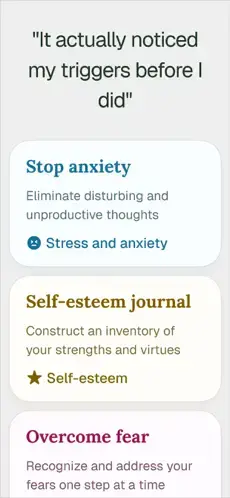
Onboarding begins with a concern-selection step, where users identify their primary issues — such as anxiety, stress, or low mood — to shape the app's initial approach. From there, users are dropped into a text-based chat interface with the AI companion, which responds in a conversational, session-like format.
The AI adapts as conversations develop. Rather than delivering pre-scripted answers, it follows the thread of what users share, asks follow-up questions, and adjusts the type of support offered. Over time, Elomia builds contextual understanding based on conversation history, which informs the specificity and relevance of its guidance.
CBT-inspired prompts appear throughout conversations to help users identify cognitive distortions — labeled within the interface as "Distortion Found" — and shift toward more constructive thinking patterns. Users can also request personalized exercises based on what has been discussed, generating tailored reflections rather than generic worksheets.
The SOS feature, described as the first of its kind in mental health apps, activates during difficult moments. It begins with a quick emotional placement check, then generates a custom exercise suited to the user's current state, alongside access to emergency contacts and crisis resources — all without requiring prolonged in-app engagement.
The Observations feature runs passively in the background, tracking context and risk factors from conversations to improve the quality and appropriateness of AI responses over time. Users can also export their full chat history — to share with a therapist, a trusted person, or for personal reference — via a one-tap function. The app is available on iOS and Android, and conversations can be deleted at any time.
Strongest Points:
✓ Clinician-designed chatbot with CBT and DBT foundations, not a generic AI assistant
✓ SOS feature provides real-time, personalized crisis support with emergency contact access
✓ Passive Observations system improves response quality based on conversation history
✓ Full chat export allows integration with professional therapy or trusted contacts
✓ No personal identifying information required — operates as an anonymous, private tool
Weaker Points:
✕ Free version is limited — message count is capped, which users frequently report as a friction point
✕ AI responses can become repetitive over extended use, particularly on free tier
✕ Privacy policy lacks full clarity on data use distinctions between ordinary and crisis-related interactions
✕ Does not provide diagnosis, crisis intervention at clinical level, or connection to live professionals
✕ Pricing options (weekly, monthly, annual) are relatively fragmented and can be expensive at higher tiers


How to Use
Onboarding begins with a concern-selection step, where users identify their primary issues — such as anxiety, stress, or low mood — to shape the app's initial approach. From there, users are dropped into a text-based chat interface with the AI companion, which responds in a conversational, session-like format.
The AI adapts as conversations develop. Rather than delivering pre-scripted answers, it follows the thread of what users share, asks follow-up questions, and adjusts the type of support offered. Over time, Elomia builds contextual understanding based on conversation history, which informs the specificity and relevance of its guidance.
CBT-inspired prompts appear throughout conversations to help users identify cognitive distortions — labeled within the interface as "Distortion Found" — and shift toward more constructive thinking patterns. Users can also request personalized exercises based on what has been discussed, generating tailored reflections rather than generic worksheets.
The SOS feature, described as the first of its kind in mental health apps, activates during difficult moments. It begins with a quick emotional placement check, then generates a custom exercise suited to the user's current state, alongside access to emergency contacts and crisis resources — all without requiring prolonged in-app engagement.
The Observations feature runs passively in the background, tracking context and risk factors from conversations to improve the quality and appropriateness of AI responses over time. Users can also export their full chat history — to share with a therapist, a trusted person, or for personal reference — via a one-tap function. The app is available on iOS and Android, and conversations can be deleted at any time.
Strongest Points:
✓ Clinician-designed chatbot with CBT and DBT foundations, not a generic AI assistant
✓ SOS feature provides real-time, personalized crisis support with emergency contact access
✓ Passive Observations system improves response quality based on conversation history
✓ Full chat export allows integration with professional therapy or trusted contacts
✓ No personal identifying information required — operates as an anonymous, private tool
Weaker Points:
✕ Free version is limited — message count is capped, which users frequently report as a friction point
✕ AI responses can become repetitive over extended use, particularly on free tier
✕ Privacy policy lacks full clarity on data use distinctions between ordinary and crisis-related interactions
✕ Does not provide diagnosis, crisis intervention at clinical level, or connection to live professionals
✕ Pricing options (weekly, monthly, annual) are relatively fragmented and can be expensive at higher tiers
Use it For:
🗣️ Individuals seeking a low-barrier, stigma-free space to talk through emotional difficulties without scheduling or social pressure
🧠 Users managing recurring anxiety, stress, or low mood who benefit from structured CBT-style reflection on a daily basis
🆘 People who want a reliable first-response tool during moments of emotional crisis, with immediate access to personalized exercises and emergency contacts
📋 Therapy clients who want to document their emotional experience and share conversation history with their therapist for added continuity
🔒 Privacy-conscious users who need anonymous emotional support without creating accounts or sharing identifying information
App Usable on:
Phone
Tablet
PC
TV
Applications and Features
Elomia's core function is sustained, conversational emotional support through AI. The chat interface is the primary workspace — clean, modern, and built around a familiar messaging format that reduces friction for first-time users. The AI responds with empathy-oriented language trained on therapist consultation data, making interactions feel notably less mechanical than standard chatbots.
The distortion identification system is one of the more clinically specific features in the consumer mental health app space. Rather than generically encouraging users to "think positively," it surfaces and names the specific cognitive pattern at play — something typically reserved for structured CBT sessions.
Personalized exercise generation allows users to prompt Elomia based on the content of an ongoing conversation, producing exercises relevant to their current situation rather than drawing from a generic library. The quality of this feature improves as the AI accumulates more conversational context.
The SOS module goes beyond a simple crisis hotline list. It generates moment-specific calming exercises tied to where the user is emotionally at that precise point in time, functioning as a structured de-escalation tool. The Observations background tracker adds a layer of longitudinal intelligence — the app is not starting from zero each session, but building a continuous picture of the user's emotional landscape.
The app also provides affirmations, article recommendations, book and film suggestions, and motivational content curated based on conversation history — extending its utility beyond reactive support into proactive wellness.
▽ Gadgets Related to this App ▽
App Summary
Elomia occupies a specific and well-defined position in the mental health app landscape: a clinician-informed, conversation-first AI companion that goes meaningfully further than standard mood trackers or journaling tools. Its CBT and DBT grounding gives it credibility, and features like the SOS module and Observations system show a level of design intent that distinguishes it from simpler chatbot alternatives.
The app works best for users who engage with it consistently and treat it as an ongoing companion rather than a one-off resource. Its personalization improves over time, and the quality of exercises and reflections scales with the depth of conversation history. The free tier's message cap and some questions around data transparency are genuine limitations worth noting — but for individuals who want structured, private, and always-available emotional support without the barriers of formal therapy, Elomia delivers a thoughtfully built product.
Pricing:
Free
Cheap
Mid
Pricy
High
Free
Cheap
Mid
Pricy
High
Free
Cheap
Mid
Pricy
High
Free
Cheap
Mid
Pricy
High
Free
Cheap
Mid
Pricy
High
Elomia offers a limited free version and paid subscriptions at $9.99 per week, $28.99 per month, or $98.99 per year. The weekly tier is disproportionately expensive for longer-term use, and the free version's message cap is a notable limitation for consistent daily engagement.
Learning Difficulty:
Elomia's interface is built around a familiar text chat format with no complex setup or configuration required. The onboarding process guides users through concern selection in a few taps, and the conversational interaction model is immediately intuitive from the first session.
Required Skill Sets:
Elomia requires no background in psychology, therapy, or technology — the AI companion leads the conversation and adapts to the user's pace and needs from the start.
Educational Content:
▽ Related Apps ▽

Stoic guides users through daily morning preparation and evening reflection using Stoic philosophy principles, combining journaling prompts, mood tracking, breathing exercises, guided meditations, and habit tracking into a single mental wellness routine.

Zero tracks fasting windows with a real-time timer across multiple intermittent fasting protocols, while adding mood journaling, weight tracking, body milestone notifications, hydration goals, meal photo logging, and an expert content library to support consistent fasting habits.

Teladoc Health lets patients schedule a video, phone, or chat visit with a licensed doctor, therapist, or specialist and receive prescriptions or care recommendations without an in-person appointment.

1/4
Questions & Answers: ⮛ (click to open)
How does Elomia differ from talking to a general-purpose AI like ChatGPT for emotional support?
Elomia is specifically trained on therapist consultation data and structured around clinical frameworks including CBT and DBT, meaning its responses follow therapeutic logic rather than general conversational AI patterns. It also includes purpose-built features like distortion identification, SOS crisis tools, and passive Observations tracking — none of which exist in general-purpose AI assistants.
Is any account or personal information required to use Elomia?
The app is designed to function without collecting personal identifying information. Users do not need to create a traditional account, and conversations can be deleted at any time, making it one of the more privacy-preserving options in its category.
What happens if Elomia detects that a user is in serious distress?
The app includes an AI-driven detection layer that identifies when a conversation is moving into territory that may require more than chatbot support. In those cases, it redirects users toward appropriate resources such as crisis hotlines or professional mental health services, rather than continuing the conversation as normal.
Can Elomia conversations be shared with a human therapist?
The app includes a one-tap chat export function that compiles full conversation history into a shareable format. This allows users to hand off context directly to a therapist, a trusted contact, or anyone involved in their wider support network — without having to recount everything from memory.
Good to Knows: ⮛ (click to open)
BMC Psychology published research associating Elomia-based chatbot interventions with measurable reductions in anxiety and depression among student populations, adding independent academic credibility to the app's claims
Elomia's AI is reported to detect when a user's situation may exceed what a chatbot can appropriately address, and redirects them toward professional resources or crisis hotlines at that point
The full conversation export feature is a practical differentiator — users can bring the context of months of app interactions directly into a first session with a therapist
Takeaways: ⮛ (click to open)
Elomia's value is most evident in consistent, long-term use — the AI's context-building and personalization improve with every conversation, making early interactions less representative of the full experience
The SOS feature is one of the more practically designed crisis tools in the consumer mental health space, offering structured, moment-specific support rather than a static list of resources
Data privacy practices deserve attention before committing — while Elomia does not collect personally identifying information, the distinction between how standard and crisis-related data is handled is not fully transparent in its current policy documentation
Did You Get Any of That?
Related Science Articles:
Explore Other App Solutions With our Blogs
Discover how different apps approach common challenges, what they do well, and where they fall short — helping you understand which tools are best suited for your specific goals and daily routines.
Swipe Less, Talk Better: 5 AI Dating Apps That Might Actually Fix Your Texting
Five AI dating and relationship apps compared — find out which ones build real skills and which ones just write your messages for you.

Gadgifyr Apps
July 30, 2026
-
9 min

The Quiet Ones: 5 Apps Doing Something No One Else Bothered To
Five genuinely inventive apps compared — find out which ones are simply clever and which are actually useful.
Gadgifyr Apps
July 19, 2026
-
9 min

After You Hit "Book": 5 Apps That Make the Trip Itself Better
Five travel apps compared on what they offer before, during, and after the trip — beyond flights, hotels, and bookings.
Gadgifyr Apps
July 14, 2026
-
9 min

Notes That Talk to Each Other: 5 Apps for Thinking, Not Just Typing
Obsidian, Notion, Evernote, OneNote, and Joplin compared — find out which one turns scattered notes into a system that actually connects your ideas.
Gadgifyr Apps
July 11, 2026
-
9 min




Where Curiosity Finds Its Match
Dive into Gadgifyr’s world of honest gadget reviews, scientific clarity, app reviews, and real tools designed to make everyday life smarter and simpler.
Clarity Behind Every Tool
Gadgifyr reviews apps and gadgets through structured analysis and science-backed insight. It focuses on how tools actually work, where they deliver real value, and how they fit into everyday routines.
Each review highlights functionality, usability, and limitations in a clear and practical way. This approach helps users understand which tools are worth using and make informed decisions with confidence.


Why People Trust Gadgifyr App Reviews
Because we go beyond popularity — we uncover new apps, explain how they work, and show what truly adds value. From hidden tools to well-known platforms, we help you understand what fits your needs.


