

Merlin Bird ID
Merlin Bird ID identifies birds in real time by listening to their songs and calls, analyzing uploaded photos, or guiding users through a short set of questions about what they saw.
The free birding app that turns any outdoor moment into a field lesson.
Merlin Bird ID is a free mobile app developed by the Cornell Lab of Ornithology at Cornell University. It helps anyone — from first-time bird spotters to experienced birdwatchers — identify the birds they see and hear, anywhere in the world. What sets Merlin apart from most nature identification apps is that it works without a subscription or paywall of any kind. Every feature is free, and the app is backed by one of the most respected ornithology institutions in the world.
The app draws its identification power from eBird, the Cornell Lab's global citizen science database containing over a billion bird sightings contributed by millions of birdwatchers worldwide. This means that when Merlin suggests a bird match, it draws on real field data from the user's location and time of year — not just a general database. The app covers over 10,000 species globally and supports Sound ID for more than 2,000 species. It is available on iOS and Android, fully free, and has been downloaded over 10 million times on Android alone.
Apps are frequently updated and may change over time. While we aim to keep our reviews accurate and up to date, some information may become outdated or no longer reflect the current version.
Disclaimer ▽ (click open)
How to Use
Merlin Bird ID offers four distinct ways to identify a bird, giving users flexibility depending on what they have available — a sound, a photo, or just a memory of what they saw.
The most talked-about feature is Sound ID. Tapping the Sound ID button opens a live listening interface. Merlin begins analyzing the audio environment in real time, displaying the names and photos of any birds it detects as they call or sing — even when multiple species are vocalizing at once. Users can save recordings to review later. These recordings are stored only on the device and are never transmitted to Cornell without the user's consent.
Photo ID works by uploading or taking a photo of a bird. The app analyzes the image and returns the most likely species matches, drawing on millions of annotated photos from the Macaulay Library.
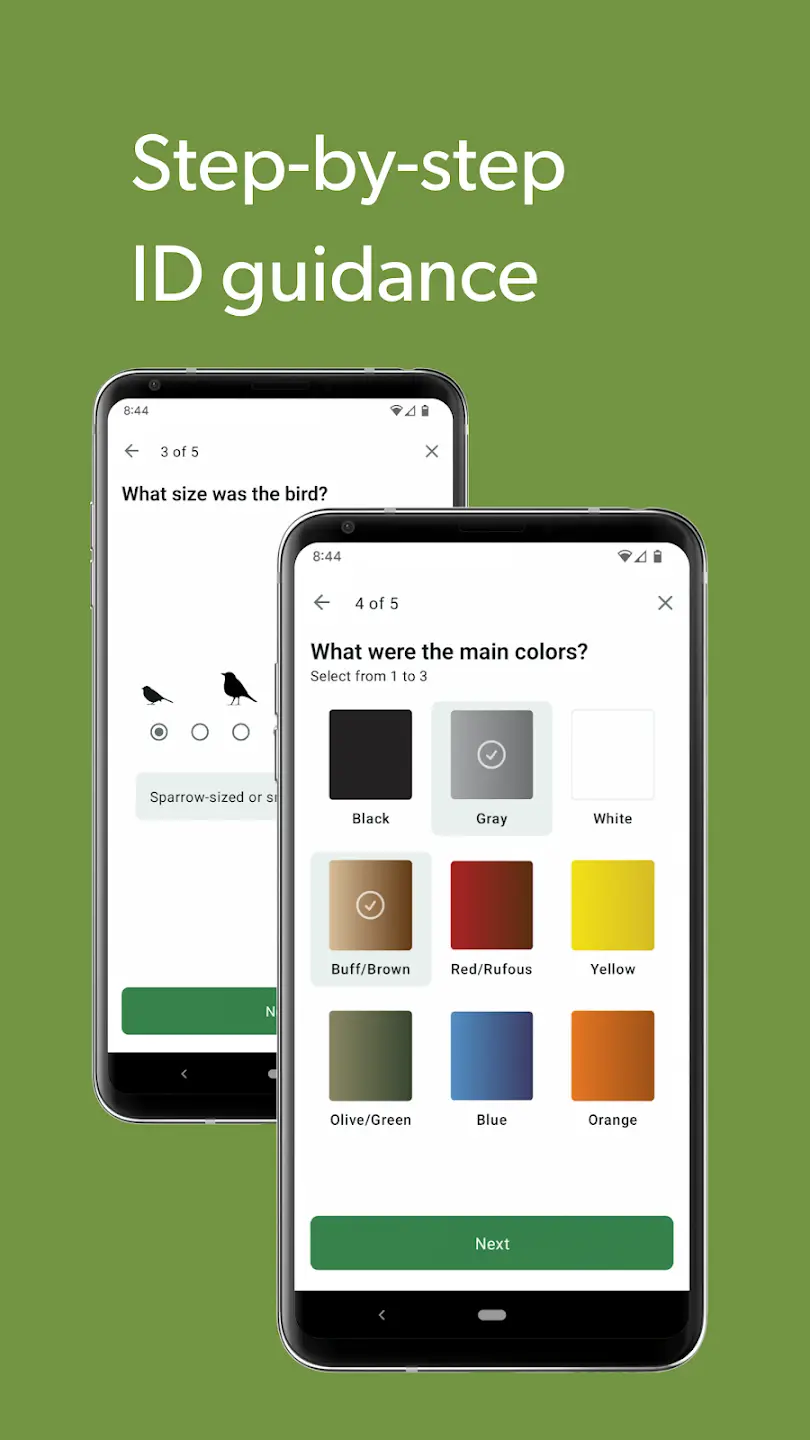
The Start Bird ID method guides users through five quick questions — location, date, bird size, main color, and behavior — and returns a customized shortlist of species most likely to be present in that place at that time of year. This approach is useful when a clear photo is not possible.
The Explore section lets users browse birds by region or search for specific species. Each entry includes expert identification tips, range maps, multiple photos, and sound recordings from the Macaulay Library. A personal life list tracks every species a user has identified, and a daily Bird of the Day feature surfaces new species for casual discovery.
Strongest Points:
✓ Completely free — no subscription, no paywall, no ads
✓ Real-time Sound ID identifies multiple bird species simultaneously from ambient sound
✓ Backed by Cornell Lab of Ornithology and powered by eBird's billion-plus observation database
✓ Four identification methods covering sound, photo, guided questions, and manual exploration
✓ Covers 10,000+ species globally with expert range maps, photos, and sound recordings
Weaker Points:
✕ Sound ID performance depends on microphone quality and background noise conditions
✕ Accuracy in regions with limited eBird observation data can be reduced
✕ Bird packs for specific regions must be downloaded manually, requiring advance preparation
✕ Saved sound recordings are lost if the app is deleted and reinstalled
✕ Login and account requirements frustrate some users who expect instant, frictionless access



How to Use
Merlin Bird ID offers four distinct ways to identify a bird, giving users flexibility depending on what they have available — a sound, a photo, or just a memory of what they saw.
The most talked-about feature is Sound ID. Tapping the Sound ID button opens a live listening interface. Merlin begins analyzing the audio environment in real time, displaying the names and photos of any birds it detects as they call or sing — even when multiple species are vocalizing at once. Users can save recordings to review later. These recordings are stored only on the device and are never transmitted to Cornell without the user's consent.
Photo ID works by uploading or taking a photo of a bird. The app analyzes the image and returns the most likely species matches, drawing on millions of annotated photos from the Macaulay Library.
The Start Bird ID method guides users through five quick questions — location, date, bird size, main color, and behavior — and returns a customized shortlist of species most likely to be present in that place at that time of year. This approach is useful when a clear photo is not possible.
The Explore section lets users browse birds by region or search for specific species. Each entry includes expert identification tips, range maps, multiple photos, and sound recordings from the Macaulay Library. A personal life list tracks every species a user has identified, and a daily Bird of the Day feature surfaces new species for casual discovery.
Strongest Points:
✓ Completely free — no subscription, no paywall, no ads
✓ Real-time Sound ID identifies multiple bird species simultaneously from ambient sound
✓ Backed by Cornell Lab of Ornithology and powered by eBird's billion-plus observation database
✓ Four identification methods covering sound, photo, guided questions, and manual exploration
✓ Covers 10,000+ species globally with expert range maps, photos, and sound recordings
Weaker Points:
✕ Sound ID performance depends on microphone quality and background noise conditions
✕ Accuracy in regions with limited eBird observation data can be reduced
✕ Bird packs for specific regions must be downloaded manually, requiring advance preparation
✕ Saved sound recordings are lost if the app is deleted and reinstalled
✕ Login and account requirements frustrate some users who expect instant, frictionless access
Use it For:
🦜 Birdwatchers at all levels who want a reliable, expert-backed identification tool they can carry into the field at no cost.
🚶 Walkers and hikers who hear unfamiliar birdsong on trails and want an instant, accurate answer without stopping to search.
🎓 Students and educators in biology, ecology, or environmental science looking for a field-ready identification and reference tool.
🌍 Travelers who want to identify birds in unfamiliar regions, supported by global species coverage and downloadable regional bird packs.
👨👩👧 Families with children interested in nature who want an engaging, educational tool that works outdoors in real time.
App Usable on:
Phone
Tablet
PC
TV
Applications and Features
The defining feature of Merlin Bird ID is its real-time Sound ID engine. Trained on over 750,000 bird sound recordings contributed by citizen scientists through eBird, the system converts audio into spectrograms — visual representations of sound — and applies the same image classification algorithms used in Photo ID. The result is a live, continuously updating display of every bird species detected in the surrounding environment. This is a technically significant achievement, and it is available for free.
Photo ID uses machine learning models trained on millions of annotated images from the Macaulay Library — one of the world's largest archives of wildlife audio and photography. The system factors in the user's location and the time of year to narrow down likely candidates before presenting results.
The guided question method is particularly effective for beginners who cannot photograph a bird. By answering five simple questions about what they observed, users receive a probability-ranked list of species filtered to their specific time and location — a feature made possible by the density of eBird's real-world sighting data.
Range maps for every species show seasonal distribution across the globe, helping users understand not just what a bird is, but where and when to expect it. The Macaulay Library content embedded in each species profile — multiple photos, multiple sound recordings, ID tips from expert ornithologists — gives the app genuine educational depth beyond a simple identification tool. The life list records a running tally of all identified species, and the Explore section allows browsing by region for trip planning or general curiosity.
▽ Gadgets Related to this App ▽
App Summary
Merlin Bird ID is one of the most well-executed free apps in its category. Developed and maintained by the Cornell Lab of Ornithology, it offers four identification methods — sound, photo, guided questions, and manual search — all backed by the eBird global database and the Macaulay Library's archive of over 80,000 photos and sounds. The real-time Sound ID feature in particular stands out as a technically impressive tool that has genuinely expanded access to birdwatching for millions of people.
It works best for users who spend time outdoors — on trails, in gardens, or traveling — and want an expert-quality reference without any cost barrier. Sound ID performance is dependent on microphone quality and quiet conditions, and accuracy in regions with sparse eBird data can be lower. But for the vast majority of users in well-documented areas, the app delivers results that rival paid alternatives. For anyone with an interest in birds, at any level, it is difficult to find a reason not to use it.
Pricing:
Free
Cheap
Mid
Pricy
High
Free
Cheap
Mid
Pricy
High
Free
Cheap
Mid
Pricy
High
Free
Cheap
Mid
Pricy
High
Free
Cheap
Mid
Pricy
High
Merlin Bird ID is completely free to use. There are no subscription tiers, no premium upgrades, and no in-app purchases of any kind. All four identification methods, the full species database, Sound ID, Photo ID, range maps, and the life list are available to every user at no cost. The app is funded and maintained by the Cornell Lab of Ornithology as part of its broader mission in ornithology research and public education.
Learning Difficulty:
The interface is designed around a single tap to begin identification, and the guided question method walks users through every step with no assumed knowledge of birds.
Required Skill Sets:
No prior knowledge of birds or ornithology is needed — the app is built for complete beginners as much as experienced birdwatchers, and all features are immediately accessible without setup.
Educational Content:
▽ Related Apps ▽

Seek identifies plants, animals, fungi, and other living things in real time by pointing the camera at them.

Sky Guide uses augmented reality and device sensors to overlay real-time astronomical data onto the night sky, allowing users to identify and learn about any visible celestial object instantly.

PictureThis identifies plants, flowers, trees, and herbs by analyzing a photo taken with a smartphone camera and instantly returns the plant's name, care instructions, and health information.

1/4
Questions & Answers: ⮛ (click to open)
How does Sound ID work when multiple birds are singing at once?
Sound ID converts the audio it hears into a spectrogram — a visual representation of sound — and applies the same image recognition technology used in Photo ID to identify the patterns. It is designed to detect and separate overlapping calls from multiple species simultaneously, displaying each identified bird in real time as it sings or calls.
Does Merlin Bird ID work without an internet connection?
The app requires an internet connection to download bird packs and to run Photo ID and Sound ID processing. Once bird packs are downloaded, basic browsing and the guided question method can work offline to a degree, but identification features that rely on server-side machine learning require connectivity.
Is Merlin Bird ID useful outside the United States and Canada?
Yes — the app covers over 10,000 species globally, with regional bird packs available for countries across the Americas, Europe, Asia, Africa, and Oceania. Sound ID currently covers more than 2,000 species, with ongoing expansion. Accuracy in regions with fewer eBird observations may be lower, but coverage for most populated areas is solid.
How does Merlin compare to paid birding apps?
Merlin holds up well against paid alternatives for most everyday birding use cases. Its Sound ID and Photo ID engines are technically comparable to or ahead of many paid tools, and its eBird-powered location filtering is a genuine advantage. Where paid apps sometimes pull ahead is in features like offline species audio libraries, more granular logging tools, or community features. For casual to intermediate birders, Merlin's free offering is more than sufficient.
Good to Knows: ⮛ (click to open)
Regional bird packs need to be downloaded before heading into areas with limited connectivity — packs are free but require a stable internet connection to install.
Sound recordings saved within the app are stored only on the device. Deleting and reinstalling the app will erase those recordings, so users who want to keep them should back them up first.
Merlin connects to eBird, meaning any sightings logged in Merlin can be submitted to the global eBird database, contributing to real ornithological research.
Takeaways: ⮛ (click to open)
Merlin is the rare app that is both genuinely free and genuinely good — there is no stripped-down tier designed to push users toward a paid upgrade.
The more eBird observations that exist for a location, the more accurate Merlin's location-based suggestions become — making it more powerful in areas with active birding communities.
Did You Get Any of That?
Related Science Articles:
Explore Other App Solutions With our Blogs
Discover how different apps approach common challenges, what they do well, and where they fall short — helping you understand which tools are best suited for your specific goals and daily routines.
Swipe Less, Talk Better: 5 AI Dating Apps That Might Actually Fix Your Texting
Five AI dating and relationship apps compared — find out which ones build real skills and which ones just write your messages for you.

Gadgifyr Apps
July 30, 2026
-
9 min

The Quiet Ones: 5 Apps Doing Something No One Else Bothered To
Five genuinely inventive apps compared — find out which ones are simply clever and which are actually useful.
Gadgifyr Apps
July 19, 2026
-
9 min

After You Hit "Book": 5 Apps That Make the Trip Itself Better
Five travel apps compared on what they offer before, during, and after the trip — beyond flights, hotels, and bookings.
Gadgifyr Apps
July 14, 2026
-
9 min

Notes That Talk to Each Other: 5 Apps for Thinking, Not Just Typing
Obsidian, Notion, Evernote, OneNote, and Joplin compared — find out which one turns scattered notes into a system that actually connects your ideas.
Gadgifyr Apps
July 11, 2026
-
9 min




Where Curiosity Finds Its Match
Dive into Gadgifyr’s world of honest gadget reviews, scientific clarity, app reviews, and real tools designed to make everyday life smarter and simpler.
Clarity Behind Every Tool
Gadgifyr reviews apps and gadgets through structured analysis and science-backed insight. It focuses on how tools actually work, where they deliver real value, and how they fit into everyday routines.
Each review highlights functionality, usability, and limitations in a clear and practical way. This approach helps users understand which tools are worth using and make informed decisions with confidence.


Why People Trust Gadgifyr App Reviews
Because we go beyond popularity — we uncover new apps, explain how they work, and show what truly adds value. From hidden tools to well-known platforms, we help you understand what fits your needs.


