
Food Washing, Contamination & Myths
Most people rinse their fruits, vegetables, and meat out of habit, assuming water alone makes food safer. Research on real washing methods tells a more complicated story — some habits genuinely reduce risk, while one common practice may do the opposite.

Gadgifyr
June 17, 2026
8 min read
Real - World Performance
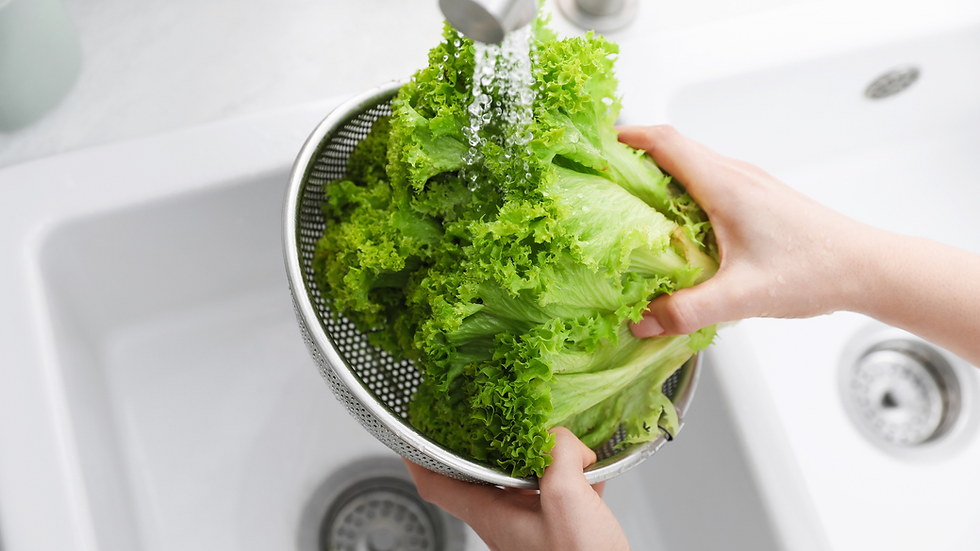
⚙️Running water works best for produce. Rinsing fruits and vegetables under the tap removed pesticide residue better than any other method tested, including soap and specialty soaks.
⚙️Bleach kills bacteria fast, at the right dose. Diluted household bleach eliminated over 99.999% of Salmonella and E. coli within a minute, but too little won't work and too much isn't food-safe.
⚙️Baking soda underperforms against bacteria. Despite its reputation as a gentle, natural cleaner, it barely reduced bacterial counts even after ten minutes of soaking.
⚙️Vinegar is inconsistent. It worked well against Salmonella but was far less reliable against Listeria, so it shouldn't be treated as a universal disinfectant.
⚙️Washing raw poultry backfires. It doesn't reduce bacteria on the meat and instead spreads it to the sink and nearby food through splashing.
⚙️Peeling beats washing for pesticides. Removing the skin cut residue more thoroughly than any wash method, though it also removes fiber and nutrients found in the skin.
Good to Know
🔍Contamination often starts in the field, not the kitchen. Bacteria can reach produce through contaminated soil, irrigation water, or manure long before harvest, so washing reduces but can't guarantee zero risk.
🔍Dish soap was the weakest method tested for pesticide removal. It's designed to cut grease, not pull chemical residue off produce surfaces.
🔍Not all bacteria respond the same way to the same treatment. A method that works well against Salmonella may barely touch Listeria, so no single wash guarantees protection against every pathogen.
🔍Larger, leafier vegetables tend to lose more pesticide residue when washed. More exposed surface area means more contact with running water.
🔍Bleach solutions used in testing were far more dilute than bottled bleach. Using it undiluted isn't safer — it's simply unsafe to eat.
🔍Most consumers who wash raw poultry aren't being careless. The majority in one survey didn't even know the practice was discouraged.
🔍Peeling removes more pesticide residue than any washing method. But it also removes the fiber and some nutrients found just under the skin.
Before dinner starts, most people run vegetables under the tap, give fruit a quick scrub, or rinse a chicken breast in the sink. It feels like basic hygiene.
But is that instinct backed by evidence, or a habit passed down without anyone checking if it works? Researchers have directly tested different washing methods against real bacteria and chemical residues to see what actually gets removed.
Some results confirm what people assume. Others contradict it entirely, including one common kitchen habit that may do more harm than good.
Did You Know?
Boiling or blanching vegetables can sometimes leave more pesticide residue behind than before cooking. As water evaporates during heating, whatever chemical remains on the food gets concentrated rather than washed away — the opposite of what most people assume cooking does. That's why washing thoroughly before boiling matters more than the boiling itself.
Food doesn't arrive in the kitchen clean. Fresh produce can pick up pathogens — disease-causing bacteria — while it's still growing, through contact with contaminated soil, irrigation water, animal manure used as fertilizer, or wildlife passing through the field.
These bacteria can settle onto leaves and skins long before harvest, sometimes in places a simple rinse can't fully reach. Many crops are also treated with pesticides — chemicals used to protect plants from insects, fungi, and weeds — leaving trace amounts, called residues, on the surface after harvest.
By the time food reaches a kitchen, it may carry two very different problems: living bacteria and chemical residue. Washing is meant to tackle both, but what works against one doesn't always work against the other.

A comparative study testing nine different washing approaches on leafy greens found real differences in how well they remove pesticide residue. Rinsing under running water was the most effective method, cutting residue by an average of 77%, while soaking in dish detergent was the least effective, removing under 44%.
Boiling helped too, but for a few specific pesticides it actually left more residue behind than before cooking — likely because water evaporates during heating and concentrates the remaining chemical.
Against bacteria, the pattern looked different: diluted household bleach (sodium hypochlorite) wiped out more than 99.999% of Salmonella and E. coli within one minute, while baking soda barely reduced bacteria at all, even after ten minutes in hot water.
Vinegar landed in between, working well against Salmonella but less reliably against Listeria, a bacterium linked to serious illness in pregnant people and older adults.
One finding stood apart: washing raw chicken under the tap did not reduce bacteria on the meat — instead, it splashed contamination onto the sink and, indirectly, onto ready-to-eat salad greens nearby.
By The Numbers
In one U.S. survey of over 1,800 consumers, 73.5% admitted to washing raw poultry before cooking it, even though food safety guidance has long advised against it. Most of them, 68.1%, said they simply didn't know the practice was discouraged. Once shown a short educational message explaining why, more than 8 in 10 said they felt confident they could stop — suggesting the habit persists less from stubbornness and more from a gap in information reaching home cooks.
For most home cooks, the practical takeaway is simple: rinsing fruits and vegetables under running water is worth doing, and it's the most effective single step for cutting pesticide residue — no special products required.
Skip the dish soap soak; it was the weakest method tested and can leave behind its own residue. Baking soda, often recommended as a gentle produce cleaner, is unlikely to meaningfully reduce bacteria, so it shouldn't be relied on if the concern is food poisoning rather than surface dirt.
If produce will be boiled or blanched anyway, washing it thoroughly first still matters, since cooking alone doesn't reliably finish the job. The biggest behavior change worth making has nothing to do with vegetables at all: washing raw poultry under the tap doesn't make it safer, and the splashing it causes can spread bacteria to countertops, sponges, and any food nearby that won't be cooked, like salad.
KEY STATISTICS
77%
Running Water's Edge
In a comparative study of nine washing methods, plain running water removed an average of 77% of pesticide residue from leafy greens — more than any detergent, acid, or specialty soak tested.
>99.999%
A 100,000-Fold Drop
A 'log reduction' is how scientists measure how much a treatment cuts bacteria — each step is a ten-times drop. Diluted household bleach achieved more than a 5-log reduction of Salmonella and E. coli in one minute, meaning over 99.999% of the bacteria present were killed.
73.5%
Most People Still Do It
Nearly 3 in 4 U.S. consumers surveyed said they wash raw poultry before cooking, despite official guidance advising against it for years.
Taken together, the research paints a picture that's more nuanced than either extreme — obsessively scrubbing everything, or not bothering to wash anything at all. Plain running water does most of the real work for produce, chemistry-based solutions work best against bacteria when used at tested strengths, and one deeply ingrained habit, washing raw meat, turns out to work against the goal it's meant to serve.
For anyone browsing produce washes, sprays, or soak tablets, the research points to a few concrete checks. Products built around plain water agitation, or a diluted food-safe sanitizer with a stated concentration (such as sodium hypochlorite or citric acid), line up with what actually reduced bacteria and pesticide residue in testing — and the studies that worked used precise concentrations and exact soaking times, not vague ones.
Vague marketing, like "naturally removes 99% of germs" without naming an active ingredient, concentration, or contact time, isn't backed by anything the tested science measured. Baking soda–based soaks marketed as bacteria-killers deserve particular skepticism, since baking soda performed worst against bacteria in direct testing.
Before buying, check the label for a named active ingredient and clear dilute-or-rinse instructions — signs a product was actually tested rather than riding on the general idea that "washing is good." No product changes the one behavior that matters most: raw poultry should never be washed, regardless of what any spray claims.
RELATED READING

Gadgifyr could not find any relatable books about this topic that were not to advanced and/or technical.
-

EVIDENCE-BASED RELIABILITY
74%
Overall Score
7
Sources Used
4
Claim Types
76%
82%
38%
Running water reduces pesticide residue
Washing raw poultry increases contamination risk
Long-term Studies
This topic draws on multiple peer-reviewed, tested studies — including controlled lab experiments on bacteria and a large comparative pesticide-washing study — rather than assumption or tradition. The bacterial and pesticide-removal findings are fairly consistent across studies, and the poultry-washing findings come from both an observed-behavior study and a survey. The main limitations are scale: most experiments were done in controlled lab settings on specific pathogen strains and vegetable types, so results may not generalize perfectly to every food, kitchen, or real-world bacteria level.
Running Water Rinse
Highly Effective
Bleach-Based Wash
Very Effective
Vinegar Rinse
Moderate
Peeling Produce
Excellent
Washing Raw Poultry
Counterproductive
Baking Soda Soak
Poor
AT A GLANCE - METRIC ACCURACY
The Consumer Takeaway
Washing food turns out to be neither the empty ritual skeptics dismiss it as, nor the all-purpose safety net many people assume it is. The evidence shows real, measurable value: plain running water removes the majority of pesticide residue from produce, more effectively than dish soap or specialty soaks, and properly diluted sanitizing solutions can eliminate the vast majority of harmful bacteria in under a minute.
But the research is just as clear about where washing doesn't help. Baking soda, popular as a natural produce cleaner, barely touches bacteria. And the most striking finding cuts against decades of kitchen habit: washing raw poultry doesn't make it safer — it can make things worse, spreading bacteria through splashing rather than removing it.
What ties these findings together is that effectiveness depends entirely on the method matching the problem: water for pesticide residue, precise sanitizer concentrations for bacteria on produce, and, for poultry, no washing at all. The instinct to wash food isn't wrong — it just needs to be aimed at the right target, with the right method, to actually do what people expect it to do.
Alegbeleye, O. O., Singleton, I., & Sant'Ana, A. S. (2018). Sources and contamination routes of microbial pathogens to fresh produce during field cultivation: A review. Food Microbiology.
Yang, S.-J., Mun, S., Kim, H. J., Han, S. J., Kim, D. W., Cho, B.-S., Kim, A. G., & Park, D. W. (2022). Effectiveness of different washing strategies on pesticide residue removal: The first comparative study on leafy vegetables. Foods, 11(18), 2916.
Pezzuto, A., Belluco, S., Losasso, C., Patuzzi, I., Bordin, P., Piovesana, A., Comin, D., Mioni, R., & Ricci, A. (2016). Effectiveness of washing procedures in reducing Salmonella enterica and Listeria monocytogenes on a raw leafy green vegetable (Eruca vesicaria). Frontiers in Microbiology, 7, 1663.
Yang, H., Kendall, P. A., Medeiros, L., & Sofos, J. N. (2009). Inactivation of Listeria monocytogenes, Escherichia coli O157:H7, and Salmonella Typhimurium with compounds available in households. Journal of Food Protection, 72(6), 1201–1208.
Shumaker, E. T., Kirchner, M., Cates, S. C., Shelley, L., Goulter, R., Goodson, L., Bernstein, C., Lavallee, A., Jaykus, L.-A., & Chapman, B. (2022). Observational study of the impact of a food safety intervention on consumer poultry washing. Journal of Food Protection.
Vatral, C. D., Gilman, A. D., & Quinlan, J. J. (2021). Consumer awareness of the message not to wash raw poultry, current practices, and barriers to following that message. Journal of Food Protection.
Elmastas, A., Umaz, A., Pirinc, V., & Aydin, F. (2022). Quantitative determination and removal of pesticide residues in fresh vegetables and fruit products by LC-MS/MS and GC-MS/MS. Environmental Monitoring and Assessment.
DID YOU GET ANY OF THAT?
Read a summarization of this page's content in question-answer format ▽ (click to open and collapse the content)
If washing removes pesticide residue, does that mean the food was unsafe before washing?
Not necessarily. Regulators set maximum residue limits based on safety research, and most produce tested in these studies fell within those limits even before washing. Washing reduces residue further, but it's a precaution layered on top of existing safety limits, not a fix for unsafe food.
Why doesn't washing raw chicken make it safer, if washing works for vegetables?
Bacteria on raw poultry tend to be embedded in the meat's surface rather than sitting loosely on top, so a quick rinse doesn't remove much of it. Instead, the force of the water creates droplets that carry bacteria outward, landing on the sink, counters, and nearby food.
What does 'log reduction' actually mean when a study reports it?
It's a way of describing how much a treatment cuts the number of bacteria present, in multiples of ten. A 1-log reduction means 90% of bacteria were killed; a 5-log reduction, seen with diluted bleach in testing, means over 99.999% were killed. Bigger numbers mean a much larger drop, not just a slightly better one.
Is bottled produce wash worth buying over just using tap water?
Based on the research, running water alone already removes the majority of pesticide residue, so it's a reasonable free option. A produce wash may help further if it contains a disclosed, tested active ingredient at an effective concentration, but marketing claims alone aren't evidence it outperforms water.
Does cooking food afterward cancel out the need to wash it first?
No — heat kills many bacteria, but it doesn't reliably remove pesticide residue, and in some cases boiling even left more residue behind because water evaporated and concentrated it. Washing before cooking still matters.
Gadgets Connected to These Scientific Insights
The gadgets shown here each rely on the science discussed in this article — sometimes directly, sometimes through a clever variation of the same underlying technology.
For the best experience, we recommend reading the summary first. It gives you a quick, clear understanding of how the technology works and helps you decide whether these gadgets match what you’re looking for.
Explore other Gadget Related Articles:

Hand Hygiene Explained: What the Gadgets Really Do
Everyone washes their hands — but does the tech promising to make it smarter actually change anything? Here's what the research says.

Food Washing Produces: Ultrasonic Cleaners And HOCl Compared
Two very different countertop gadgets both claim to clean your fruits and veggies better than the sink, but do they actually solve the same problem?

Does Meal Prepping Actually Make You Eat Healthier?
Millions swear by Sunday meal prep for healthier eating. Does the research actually back that up?
1 / 3


About Gadgifyr
We uncover and review gadgets that genuinely make life better — from boosting focus and energy to improving everyday comfort and wellbeing.
No exaggerations, no empty promises. Just real reviews, grounded research, and practical tech that adds value — not noise.
When a gadget makes bold claims, we test the facts, check the science, and give you the clarity you need to decide with confidence.
Join the Gadgifyr Community
Stay ahead of the curve, together.
Get involved with a community that loves smart gadgets, real reviews, and tech that actually improves life.
Subscribe to the Newsletter
No spam. Just smart tech.
Get new reviews, science insights, and hand-picked gadget drops straight to your inbox.
Explore Gadgifyr's Blogs

Gadgifyr
August 24, 2026
-
14 min read
Training Smarter: The Science of Effective Muscle Growth
A myth-checked, research-based look at what genuinely drives muscle growth — and where popular fitness claims outpace the science.
Category

Gadgifyr
January 27, 2026
-
12 min read
Heat vs. Cold Therapy: What Ice Baths, Saunas, and Contrast Therapy Actually Do
A science-backed look at heat and cold therapy — from cold plunges and saunas to contrast therapy — covering what's proven, what's still early, and which recovery gadgets hold up.
Category

Gadgifyr
February 11, 2026
-
15 min read
What plant-derived oils can realistically do for hair, sleep, mood, and everyday wellbeing
An honest, research-based breakdown of what essential oils can realistically do for sleep, hair, mood, and daily wellbeing — plus the gadgets built around them.
Category


