
Food Washing Produces: Ultrasonic Cleaners And HOCl Compared
Ultrasonic cleaners and hypochlorous acid generators both promise cleaner, safer produce, but through very different mechanisms. This article looks at what the science actually shows about pesticide removal and bacteria reduction for each.

Gadgifyr
February 8, 2026
7 min
Real - World Performance
⚙️ Ultrasonic cleaning's mechanism is real, but its edge is inconsistent. Studies show it sometimes beats plain water on pesticide residue and sometimes loses to it.
⚙️ Baking soda often matches ultrasonic cleaning. Several comparisons found a simple baking soda soak performed about as well as an ultrasonic device.
⚙️ HOCl and chlorine-based sanitizers consistently beat home remedies. Multiple studies found them clearly outperforming vinegar, baking soda, and water against foodborne bacteria.
⚙️ This chemistry is already proven at industrial scale. Electrolyzed water and similar sanitizers are established, regulator-recognized tools in commercial food processing.
⚙️ Pathogen reduction matters more than pesticide-residue shaving for most people's food safety. Bacteria like Salmonella pose a more immediate health risk.
Good to Know
🔍 Ultrasonic and HOCl gadgets solve different problems. One leans on physical force for residue, the other on chemistry for bacteria; they aren't interchangeable.
🔍 Results vary enormously by produce type. The same washing method can perform very differently on leafy greens versus grapes versus cucumbers.
🔍 A headline percentage alone isn't proof. "Removes 99% of residue" means little without knowing the specific pesticide, produce, and testing conditions behind it.
🔍 Plain water is a real baseline worth comparing against. Some studies found it outperforms fancier gadgets for pesticide removal on certain vegetables.
🔍 Consumer devices aren't always tested as rigorously as lab systems. The strongest HOCl evidence often comes from industrial-grade equipment, not the countertop version.
🔍 Even proper disinfectants have limits. Even food-industry-approved concentrations sometimes fell short of official safety benchmarks under quick, realistic contact times.
🔍 Log-reduction data is more meaningful than vague marketing claims. Look for real numbers tied to a specific pathogen and method, not just a big percentage.
Fruits and vegetables are essential to a healthy diet, but they can also carry two very different unwanted passengers: pesticide residue left from farming, and foodborne bacteria like Salmonella or Listeria picked up anywhere between the field and your kitchen counter. These aren't the same problem, and they don't respond to the same solutions.
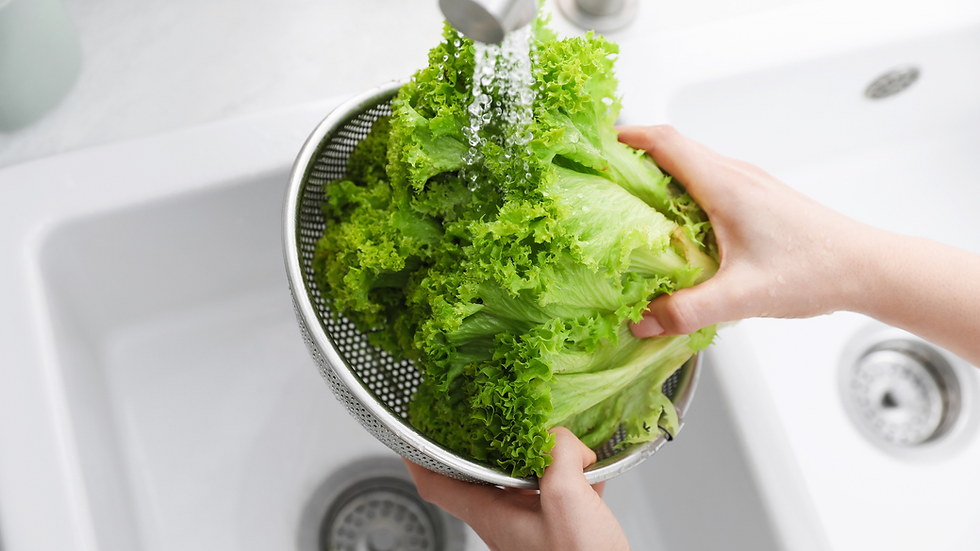
For most people, "washing produce" means a quick rinse under the tap. But countertop gadgets now promise a dramatically better job, using sound waves or specially generated water to clean produce more thoroughly than a sink ever could.
Did You Know?
In one comparison on leafy greens, plain running water actually removed more pesticide residue than an ultrasonic cleaner did, roughly 77% versus about 53%. Sometimes the simplest, free method wins against the fancier gadget.
Ultrasonic produce washers use high-frequency sound waves to create millions of tiny bubbles in water. When those bubbles collapse, they release microscopic jets of energy that physically dislodge dirt, wax, and residue from crevices, a process called cavitation. The claim is that this reaches places a simple rinse can't.
Hypochlorous acid generators work completely differently. They run an electric current through salt water, a process called electrolysis, producing a mild oxidizing compound that damages the outer walls of bacteria and other microbes on contact. Some devices also produce a second, more alkaline stream marketed specifically as a pesticide-degreasing rinse. One tool relies on physical force, the other on chemistry.

The two technologies land in very different places once you look at real testing. Ultrasonic cleaning genuinely does reduce pesticide residue in controlled studies, sometimes substantially, but the results swing wildly depending on the produce and pesticide involved. In some comparisons, plain running water actually outperformed ultrasonic cleaning; in others, a baking soda soak matched it closely. There's real physics happening, but no consistent evidence that the gadget beats free alternatives.
Hypochlorous acid tells a more consistent story. Chlorine-based sanitizers, the same chemistry underlying HOCl and electrolyzed water, have repeatedly outperformed vinegar, baking soda, and plain water at reducing Salmonella and Listeria counts in controlled lab testing, mirroring how this chemistry is already used at commercial scale in the food industry. That said, standalone consumer devices haven't been tested head-to-head with the same rigor as the lab-grade systems behind those results, and even properly diluted disinfectants sometimes fall short of official safety benchmarks under quick, real-world contact times.
By The Numbers
In lab testing against foodborne pathogens, a diluted chlorine-based solution produced over a 5-log reduction in bacteria within just one minute, while a baking soda soak barely made a dent, less than a 1-log reduction, even after ten minutes.
It's worth being clear about which problem actually matters more for safety. Pesticide residue reduction, while measurable, is often a fairly marginal health concern for most people eating a normal, varied diet. Foodborne pathogens like Salmonella and Listeria are the more serious risk, since they can cause real illness quickly.
Seen that way, a gadget that shaves off a bit more pesticide residue than plain water is a nice-to-have at best. A gadget that reliably reduces harmful bacteria on the other hand addresses the more meaningful risk, which is exactly where hypochlorous acid systems currently have the stronger evidence, and where ultrasonic devices, despite their real underlying mechanism, don't have the same track record.
KEY STATISTICS
77% vs 53%
Water Beat Ultrasonic On Residue
In a comparison of nine different washing methods on leafy greens, plain running water reduced pesticide residue by about 77%, edging out ultrasonic cleaning, which came in around 53% in the same category of testing.
5-log
Chlorine Chemistry Crushed Baking Soda
A diluted chlorine-based sanitizer produced more than a 5-log reduction in dangerous foodborne bacteria within just one minute, while a baking soda solution barely made a dent, less than a 1-log reduction, even after ten minutes.
2-log
Even Approved Disinfectants Have Limits
Even at food-industry-recommended concentrations and contact times, common disinfectants only achieved up to about a 2-log reduction against a tough virus on food-contact surfaces, well short of the 3-log benchmark regulators consider effective.
Neither of these gadgets is snake oil, exactly, but they deserve very different levels of trust. Ultrasonic cleaning is real physics that sometimes helps and sometimes doesn't beat a free alternative, while hypochlorous acid is well-established chemistry with a much more consistent safety record for actually killing pathogens, even if the specific countertop device hasn't been tested as rigorously as the industrial version of the same technology.
When comparing plain water, baking soda soaks, and vinegar to these gadgets, it helps to know their limits too: all three can remove some surface dirt and modestly reduce pesticide residue, but none of them reliably sanitize produce against bacteria the way a proper chlorine-based solution can. A splash of vinegar or a baking soda soak is a reasonable, cheap first step, not a food-safety guarantee.
Before buying either type of device, look for actual log-reduction data from independent testing, not just a headline percentage, since a claim like "removes 99% of pesticides" means very little without knowing which pesticide, which produce, and under what conditions it was tested. Compare any claimed result against plain water as the baseline, since that's often the real competition, and be skeptical of any product that doesn't cite where its numbers came from.
RELATED READING

Gadgifyr could not find any relatable books about this topic that were not to advanced and/or technical.
-

EVIDENCE-BASED RELIABILITY
66%
Overall Score
7
Sources Used
3
Claim Types
70%
30%
20%
Ultrasonic Beats Water On Pesticide Residue
HOCl Reduces Foodborne Pathogens
Long-term Studies
This topic really covers two separate products with very different evidence bases. Ultrasonic cleaning has a real, well-understood mechanism, but head-to-head studies show inconsistent results against pesticide residue, sometimes losing to plain water or baking soda. Hypochlorous acid and related chlorine-based chemistry perform far more consistently against foodborne bacteria like Salmonella and Listeria, mirroring their established, regulator-recognized use in commercial food processing, though standalone consumer devices lack the same rigorous independent testing as industrial systems. The overall score reflects strong chemistry-based evidence paired with a weaker, more inconsistent case for the physical cleaning claim.
Ultrasonic
Inconsistent
HOCl
Strong Evidence
Smaller Risk
Pesticides
Plain Water
Real Baseline
Look For
Log-Reduction Data
Bigger Risk
Bacteria
AT A GLANCE - METRIC ACCURACY
The Consumer Takeaway
Ultrasonic produce washers and hypochlorous acid generators lean on genuinely different science, and the evidence treats them very differently. Ultrasonic cleaning has a real physical mechanism, but its real-world advantage over plain water or a baking soda soak is inconsistent at best, sometimes it wins, sometimes it loses, depending on the produce and pesticide involved.
Hypochlorous acid and related chlorine-based chemistry tell a more reassuring story. This is well-established, industrially proven technology for reducing dangerous bacteria like Salmonella and Listeria, consistently outperforming home remedies like vinegar and baking soda in controlled testing. The caveat is that the specific countertop device someone buys hasn't necessarily been tested with the same rigor as the industrial systems the underlying chemistry comes from.
The most useful mental shift here is remembering that pathogen reduction matters more for health than pesticide-residue shaving, which is often a smaller concern for most people's actual diets. A gadget's real value should be judged against that priority, and against the honest baseline of what plain water and a few cents of baking soda can already do for free, before spending money on something fancier.
Morris, J. N., & Esseili, M. A. (2023). The effect of water hardness and pH on the efficacy of peracetic acid and sodium hypochlorite against SARS-CoV-2 on food-contact surfaces. Foods, 12(16), 2981.
Farah, R. I., & Al-Haj Ali, S. N. (2021). Electrolyzed water generated on-site as a promising disinfectant in the dental office during the COVID-19 pandemic. International Journal of General Medicine, 14, 1949–1955.
Ampiaw, R. E., Yaqub, M., & Lee, W. (2021). Electrolyzed water as a disinfectant: A systematic review of factors affecting the production and efficiency of hypochlorous acid. Journal of Water Process Engineering, 43, 102228.
Yusof, N. S. M., Babgi, B., Alghamdi, Y., Madhavan, J., & Ashokkumar, M. (2016). Physical and chemical effects of acoustic cavitation in selected ultrasonic cleaning applications. Ultrasonics Sonochemistry, 29, 568–576.
Muqbil, I., Burke, F. J. T., Miller, C. H., & Palenik, C. J. (2005). Antimicrobial activity of ultrasonic cleaners. Journal of Hospital Infection, 60(3), 249–255.
Yang, H., Kendall, P. A., Medeiros, L., & Sofos, J. N. (2009). Inactivation of Listeria monocytogenes, Escherichia coli O157:H7, and Salmonella Typhimurium with compounds available in households. Journal of Food Protection, 72(6), 1201–1208.
Yang, S.-J., Mun, S., Kim, H. J., Han, S. J., Kim, D. W., Cho, B.-S., Kim, A. G., & Park, D. W. (2022). Effectiveness of different washing strategies on pesticide residue removal: The first comparative study on leafy vegetables. Foods, 11(18), 2916.
DID YOU GET ANY OF THAT?
Read a summarization of this page's content in question-answer format ▽ (click to open and collapse the content)
Do ultrasonic produce washers actually remove pesticides?
Sometimes, yes, but not reliably better than plain water. Results vary a lot by produce and pesticide type, and in several studies, running water or a baking soda soak performed just as well or better.
Does hypochlorous acid actually kill bacteria on food?
Based on the available research, yes, and consistently so. Chlorine-based sanitizers like HOCl have repeatedly outperformed vinegar, baking soda, and plain water at reducing Salmonella and Listeria in controlled testing, mirroring how this chemistry is already used in commercial food processing.
Which matters more, removing pesticides or killing bacteria?
For most people's everyday food safety, reducing harmful bacteria matters more, since foodborne pathogens can cause illness quickly, while pesticide residue is usually a smaller, more marginal concern.
Is a baking soda soak just as good as an ultrasonic cleaner?
For pesticide residue specifically, several studies found baking soda performed about as well as ultrasonic cleaning. For killing bacteria, though, baking soda performed poorly compared to chlorine-based sanitizers.
Are these countertop devices tested as well as the industrial versions of this technology?
Not always. The strongest evidence for hypochlorous acid and electrolyzed water often comes from lab-grade or commercial systems, and standalone consumer devices haven't necessarily been tested with the same rigor.
What should I look for before buying one of these gadgets?
Look for real log-reduction data from independent testing, tied to a specific pathogen or pesticide, rather than a vague headline percentage, and check whether the result was compared against plain water as a baseline.
Is plain water washing good enough on its own?
It's a reasonable baseline that removes surface dirt and some residue, but it doesn't reliably kill bacteria the way a proper chlorine-based sanitizer can, so it has real limits too, especially for anyone at higher risk from foodborne illness.
Gadgets Connected to These Scientific Insights
The gadgets shown here each rely on the science discussed in this article — sometimes directly, sometimes through a clever variation of the same underlying technology.
For the best experience, we recommend reading the summary first. It gives you a quick, clear understanding of how the technology works and helps you decide whether these gadgets match what you’re looking for.


Explore other Gadget Related Articles:

Hand Hygiene Explained: What the Gadgets Really Do
Everyone washes their hands — but does the tech promising to make it smarter actually change anything? Here's what the research says.

Food Washing Produces: Ultrasonic Cleaners And HOCl Compared
Two very different countertop gadgets both claim to clean your fruits and veggies better than the sink, but do they actually solve the same problem?

Does Meal Prepping Actually Make You Eat Healthier?
Millions swear by Sunday meal prep for healthier eating. Does the research actually back that up?
1 / 3


About Gadgifyr
We uncover and review gadgets that genuinely make life better — from boosting focus and energy to improving everyday comfort and wellbeing.
No exaggerations, no empty promises. Just real reviews, grounded research, and practical tech that adds value — not noise.
When a gadget makes bold claims, we test the facts, check the science, and give you the clarity you need to decide with confidence.
Join the Gadgifyr Community
Stay ahead of the curve, together.
Get involved with a community that loves smart gadgets, real reviews, and tech that actually improves life.
Subscribe to the Newsletter
No spam. Just smart tech.
Get new reviews, science insights, and hand-picked gadget drops straight to your inbox.
Explore Gadgifyr's Blogs

Gadgifyr
August 24, 2026
-
14 min read
Training Smarter: The Science of Effective Muscle Growth
A myth-checked, research-based look at what genuinely drives muscle growth — and where popular fitness claims outpace the science.
Category

Gadgifyr
January 27, 2026
-
12 min read
Heat vs. Cold Therapy: What Ice Baths, Saunas, and Contrast Therapy Actually Do
A science-backed look at heat and cold therapy — from cold plunges and saunas to contrast therapy — covering what's proven, what's still early, and which recovery gadgets hold up.
Category

Gadgifyr
February 11, 2026
-
15 min read
What plant-derived oils can realistically do for hair, sleep, mood, and everyday wellbeing
An honest, research-based breakdown of what essential oils can realistically do for sleep, hair, mood, and daily wellbeing — plus the gadgets built around them.
Category


