
Should You Really Wash Your Food Before Eating?
Fresh fruits and vegetables can pick up microbes, dirt, and chemical residues long before they reach the kitchen. This guide explains where contamination happens, what the real health risks are, and what washing methods have evidence behind them.

Gadgifyr
January 20, 2026
6 min
Real - World Performance
⚙️ Running water is a strong default for residue reduction on leafy vegetables, outperforming detergent in comparative testing.
⚙️ For leafy greens, thorough coverage matters because large surface area increases retention of residues and microbes.
⚙️ Cut produce has higher microbial risk, so cleaning and cold storage become more important once items are chopped.
⚙️ In batch or immersion-style washing, water alone may not control cross-contamination, based on retail crisping simulations.
⚙️ For some settings, validated antimicrobial washes can meaningfully reduce pathogens, but they must be used correctly and consistently.
Good to Know
🔍 “Organic” does not mean “pathogen-free”: contamination routes can be shared across organic and conventional systems.
🔍 Leafy vegetables are harder to decontaminate because they cannot be peeled and have high surface area.
🔍 Microbial risk rises with extra handling: cut fruits/vegetables and deli-style salads tend to be more contaminated than intact produce.
🔍 Running water reduced pesticide residues more than detergent in a head-to-head leafy-vegetable comparison.
🔍 Boiling/blanching can reduce residues, but some pesticides showed lower reductions with these methods than with other strategies.
🔍 In fresh produce surveillance, product type strongly influenced detection, with mushrooms and head brassica standing out for L. monocytogenes.
🔍 Seasonality can matter: L. monocytogenes prevalence fluctuated over time and showed seasonal effects in the Netherlands dataset.
🔍 Plain water immersion can miss the cross-contamination problem in batch washing contexts, where antimicrobial options performed better.
Fresh produce is often marketed as “clean eating,” yet it is also one of the most common vehicles for foodborne exposure because it is frequently eaten raw or only lightly cooked. Contamination can occur at any stage of the production and supply chain, and it is not limited to one farming style.
Evidence summarized in research on organic foods stresses that pathogenic microorganisms can be introduced during production, harvest, handling, and distribution, with shared routes across organic and conventional systems—especially via animal activity, irrigation water, manure use, and weather conditions. That means “organic” and “local” can be excellent choices for many reasons, but they are not automatic substitutes for safe handling and cleaning.
From a safety standpoint, produce faces three broad hazard categories: physical hazards (dust, sand, wood or metal fragments), chemical hazards (including pesticides and chemicals associated with packaging or farm inputs), and biological hazards (pathogens such as Escherichia coli, Salmonella, Listeria monocytogenes, and norovirus). Outbreak reports and reviews of produce safety challenges describe how many commodity types can serve as transmission vehicles, including leafy greens and salad mixes, sprouts, cantaloupe, berries, mangos, and cut produce.
Cut fruits and vegetables generally carry a higher microbial risk profile than intact produce because cutting increases surface area, releases nutrients that support growth, and adds extra handling steps. Storage also matters: under certain conditions, pathogens can survive and sometimes grow on produce surfaces or in plant fluids; controlled low temperatures can reduce bacterial growth compared with warmer conditions.
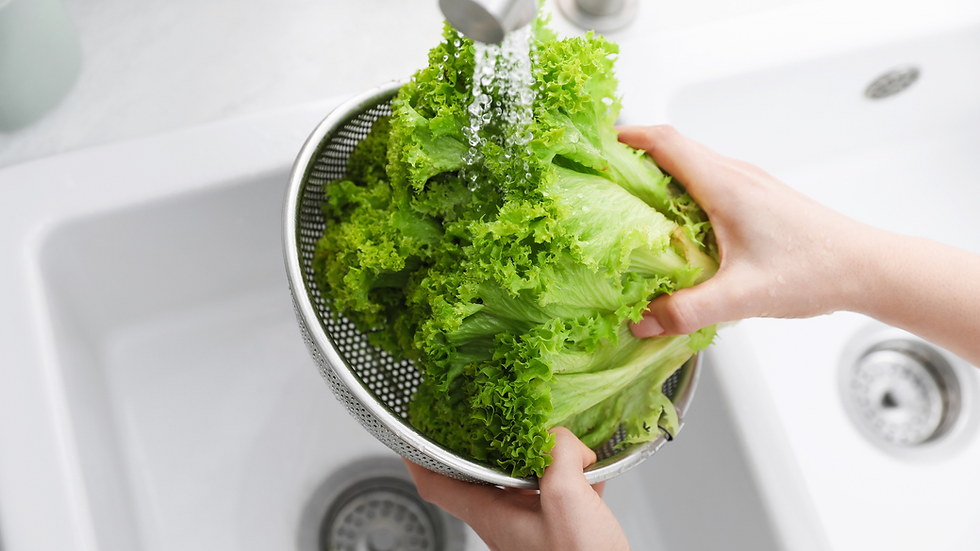
Washing is not a magic eraser, but it is one of the few consumer-controlled steps that can reduce exposure, especially for produce eaten raw. The best-supported baseline is thorough washing with running water, paired with clean handling practices to avoid transferring contaminants from the outside to the inside during cutting. For chemical residues, a comparative study on five leafy vegetables artificially contaminated with pesticides found that running water produced the highest average residue reduction (77.0% ± 18.0), while detergent performed the worst (43.7% ± 14.5); boiling also reduced residues on average, but effectiveness varied by pesticide and method.
For microbes, a separate evaluation under “retail crisping” conditions showed that antimicrobial wash solutions (peracetic acid, hypochlorous acid, accelerated hydrogen peroxide) reduced pathogens and background microbes, while water alone was ineffective at reducing foodborne pathogens and cross-contamination risks in that setting. The practical takeaway is straightforward: washing helps, but method matters, and some problems (especially cross-contamination in shared wash water) require approaches beyond plain immersion.
KEY STATISTICS
RELATED READING

Gadgifyr could not find any relatable books about this topic that were not to advanced and/or technical.
-

EVIDENCE-BASED RELIABILITY
83%
Overall Score
Sources Used
Claim Types
Long-term Studies
The evidence base includes a 10-year national surveillance dataset and controlled comparative studies on both pesticide residue removal and microbial reduction.
AT A GLANCE - METRIC ACCURACY
The Consumer Takeaway
Cleaning produce before eating is best understood as risk reduction, not perfection. Across the supply chain, fruits and vegetables can be exposed to soil, water, animals, equipment, packaging, and repeated human handling, creating opportunities for biological contamination and leaving behind chemical residues or physical debris. Controlled studies reinforce that method matters: for pesticide residues on leafy vegetables, running water achieved higher average reduction than detergent, while antimicrobial wash systems outperformed water alone in reducing pathogens and limiting cross-contamination under retail-like washing conditions.
The most defensible “facts over noise” message is that produce washing is not about fear—it is about stacking small advantages in exposure reduction, especially for foods eaten raw and for high-surface-area items like leafy greens. The science points toward simple, repeatable practices, and away from overconfident shortcuts, which is exactly the mindset that tends to shape safer future gadget-grade food handling and kitchen design.
Pradhan, A. K., Pang, H., & Mishra, A. (2019). Foodborne disease outbreaks associated with organic foods: Animal and plant products. In Safety and Practice for Organic Food (pp. 135–150). Academic Press. https://doi.org/10.1016/B978-0-12-812060-6.00006-4
Hussain, M. A., & Gooneratne, R. (2017). Understanding the fresh produce safety challenges. Foods, 6(3), 23. https://doi.org/10.3390/foods6030023
Yang, S.-J., Mun, S., Kim, H. J., Han, S. J., Kim, D. W., Cho, B.-S., Kim, A. G., & Park, D. W. (2022). Effectiveness of different washing strategies on pesticide residue removal: The first comparative study on leafy vegetables. Foods, 11(18), 2916. https://doi.org/10.3390/foods11182916
De Bock, T., Jacxsens, L., Devlieghere, F., & Uyttendaele, M. (2025). A ten-year survey of bacterial pathogens in fresh, unprocessed fruits and vegetables produced, imported, or traded in the Netherlands. Journal of Food Protection, 88(8), 100560. https://doi.org/10.1016/j.jfp.2025.100560
Mina, H. A., Buckley, D. A., Burnett, J., & Deering, A. J. (2025). Evaluation of commercially available produce antimicrobial washes to improve the quality and microbial safety of fresh produce. International Journal of Food Microbiology, 441, 111318. https://doi.org/10.1016/j.ijfoodmicro.2025.111318
DID YOU GET ANY OF THAT?
Read a summarization of this page's content in question-answer format ▽ (click to open and collapse the content)
Why can produce become contaminated even if it looks clean?
Contamination can be microscopic and introduced anywhere from farm inputs to retail handling. The supply chain includes multiple contact points where pathogens or residues can be deposited without changing appearance.
Are some produce types riskier than others?
Yes. Leafy greens and salad mixes repeatedly show higher concern because of large surface area, frequent raw consumption, and higher handling. Cut produce also trends higher risk because cutting adds handling and exposes nutrients that support microbial persistence.
Does washing fully eliminate pathogens?
No. Washing is a reduction step, not sterilization. The most useful goal is lowering surface load and preventing transfer during cutting, storage, and preparation.
Is detergent a good way to wash leafy vegetables?
Comparative testing on pesticide residues in leafy vegetables found detergent had the lowest average residue reduction among tested methods, while running water achieved the highest. That makes detergent look less effective than many people assume, at least for residue removal in that context.
What’s the hidden risk in “soaking” or batch washing?
Batch washing can create cross-contamination if contaminants move from one item to another through the shared water. Under retail crisping conditions, antimicrobial wash solutions reduced pathogens and cross-contamination more effectively than water alone.
Gadgets Connected to These Scientific Insights
The gadgets shown here each rely on the science discussed in this article — sometimes directly, sometimes through a clever variation of the same underlying technology.
For the best experience, we recommend reading the summary first. It gives you a quick, clear understanding of how the technology works and helps you decide whether these gadgets match what you’re looking for.
Explore other Gadget Related Articles:

Do Automatic Cookers Improve Food Quality - or Just Convenience?
Automatic cookers can improve consistency and nutrient retention mainly by controlling time, temperature, and moisture, but evidence that “robot chefs” cook better than humans is still limited.
Should You Really Wash Your Food Before Eating?
A science-based breakdown of food contamination sources, potential health consequences, effective washing methods, and common food-cleaning myths that don’t hold up to evidence.

Can Meal Prepping Improve Healthy Eating Habits Long Term?
A fact-based look at the science behind meal prepping, optimal prep duration and food safety, potential downsides, and the extra benefits most people overlook.
.png)
1 / 3


About Gadgifyr
We uncover and review gadgets that genuinely make life better — from boosting focus and energy to improving everyday comfort and wellbeing.
No exaggerations, no empty promises. Just real reviews, grounded research, and practical tech that adds value — not noise.
When a gadget makes bold claims, we test the facts, check the science, and give you the clarity you need to decide with confidence.
Join the Gadgifyr Community
Stay ahead of the curve, together.
Get involved with a community that loves smart gadgets, real reviews, and tech that actually improves life.
Subscribe to the Newsletter
No spam. Just smart tech.
Get new reviews, science insights, and hand-picked gadget drops straight to your inbox.
Explore Gadgifyr's Blogs

Gadgifyr
April 18, 2026
-
7 min
Clean Mouth, Clear Science: What Actually Improves Oral Hygiene
A science-guided oral care routine is built on consistent plaque control, smart fluoride use, and lifestyle choices that reduce acid exposure - while avoiding overbrushing, unnecessary abrasion, and “whitening” shortcuts that can undermine enamel protection.
Category

Gadgifyr
May 18, 2026
-
6 min
Intermittent Fasting: What It Does, What It Doesn’t, and How to Use It Safely
A practical, evidence-grounded guide to what intermittent fasting is, how it affects metabolism and appetite, where the research is strongest, what is still uncertain, and how to implement it.
Category

Gadgifyr
May 28, 2026
-
7 min
Cook Faster With Less Mess: 5 Genius Kitchen Tools That Upgrade Workflow
Want cooking to feel smoother day-to-day? These five tools improve prep speed, reduce mess, and keep ingredients moving—without turning the kitchen into a gadget collection.
Category

Gadgifyr
May 3, 2026
-
7 min
Wearable Health Tracking Demystified: What Your Smartgear Gets Right - and What It Doesn’t
An accessible exploration of how consumer wearables sense the body, which measurements hold practical value, where accuracy weakens, and how upcoming technologies could expand their medical relevance.
Category


